
If you're applying for Permanent Residence (PR) or citizenship in Singapore and any of your documents are in a language other than English, the Immigration & Checkpoints Authority (ICA) will ask for an English translation. Getting this step wrong is one of the most common reasons applications get delayed, so it's worth understanding exactly what "certified" means here.
What ICA actually requires
ICA requires foreign-language supporting documents to be submitted with an English translation that is:
- Complete — every part of the document, including stamps, seals and handwritten notes, is translated. Partial translations are rejected.
- Accurate — the translation faithfully reflects the original, with names and dates matching your other documents.
- Notarised or embassy-attested — for ICA PR, citizenship and LTVP applications, the translation must either be issued or attested by the issuing country's embassy, or notarised by a notary public. ICA's own list is: (1) translations by the embassy, (2) translations by a notary public, or (3) privately translated documents attested by the embassy or notarised by a notary public.
The translation does not have to come from a court or a government body. A translation company's certification is what ICA looks for.
Documents that usually need translation
For PR and citizenship applications, the documents most often needing certified translation are:
- Birth certificates
- Marriage certificates (and divorce or annulment records, where relevant)
- Household registers or family record books
- Police clearance / certificates of no criminal record
- Educational certificates and transcripts
When notarisation is required
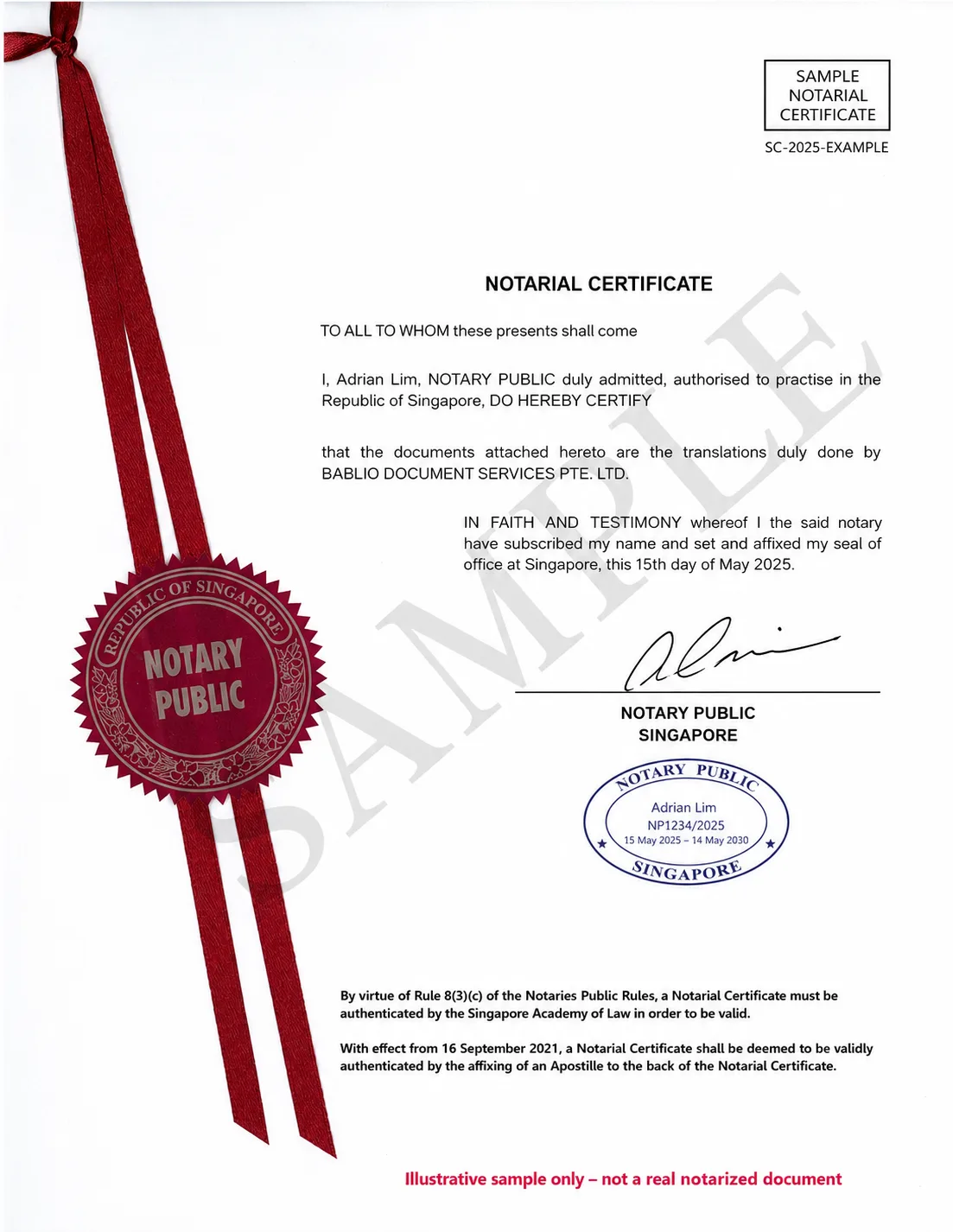
For ICA PR, citizenship and LTVP applications, the translation must be notarised (or issued/attested by the issuing country's embassy) — ICA does not accept a plain certified translation on its own. A notarised translation adds a Notary Public's attestation on top of the certification. Where the document will also be used overseas, an apostille (SAL authentication) is added on top of the notarisation. If you're unsure, it's safer to confirm the exact requirement before you submit than to have the application queried. We explain the distinction in our guide on certified vs notarised translation.
Tip: keep the names and dates on your translations identical to how they appear on your other ICA documents. A small mismatch (a middle name on one document but not another) is a frequent cause of follow-up queries.
How long it takes and what it costs
A standard single-page civil document — a birth or marriage certificate, for instance — is usually translated, checked and certified within one working day, and same-day service is often available for documents confirmed before noon. Pricing for standard one-page documents is a flat fee from around S$49 per page. If notarisation or legalisation is required, those are added as clearly-listed line items and quoted upfront.
How to get it done
- Scan or photograph each document clearly — every stamp and seal must be legible.
- Get a quote and confirm whether you need certification only, or certification plus notarisation (and apostille/SAL if the document is used overseas).
- Receive your certified translation by email (soft copy), with hard copies by courier or collection if you need them.