
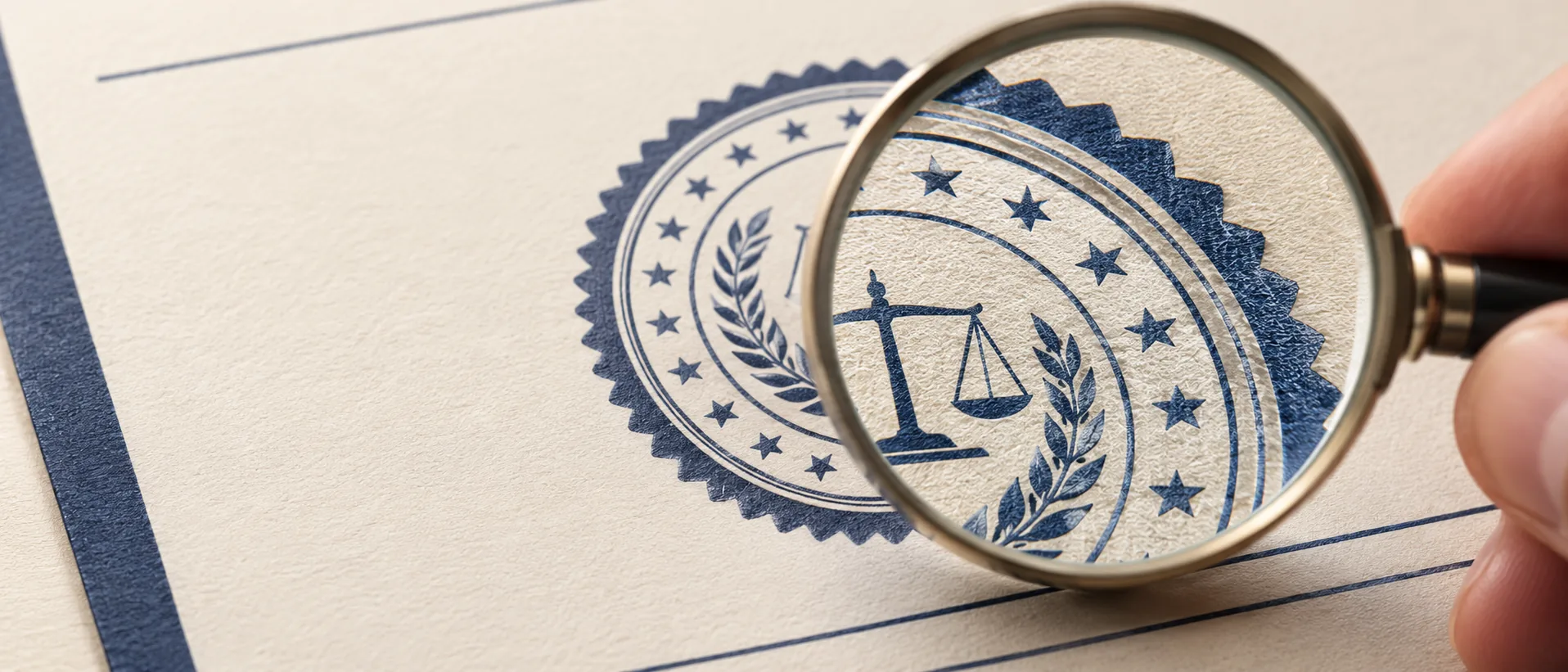
Why certified translation needs a human check is clear from Bablio’s de-identified October-November 2026 review pattern: multi-level organisation names printed inside a seal/stamp/ring (ministry/bureau/branch/purpose) are the single most recurring QC catch across Oct-Nov 2026 reflection runs — the model either drops a level or omits the original-script form. A human reviewer must therefore compare every seal component with the source before a certified translation is issued. AI can accelerate transcription and translation, but certification still depends on a complete, source-faithful document.
Why does certified translation need a human check?
The necessary level of human checking depends on the document. If a page contains a faint, circular or multi-level official seal, line-by-line human review matters because one omitted authority can change the seal’s identity; if a page contains clean, flat body text, AI may produce a reliable first draft, but a reviewer must still verify the final translation against the source.
A certified translation presents the translated document as an accurate rendering of the source. A fluent sentence is insufficient when the source also contains stamps, handwritten annotations, embossed marks or text arranged around a ring.
Human review connects each translated element to a visible source element. The reviewer checks what the seal says, how its parts relate to one another and whether the translated wording preserves the institution’s hierarchy.
The wider certified translation services in Singapore process may include document preparation, translation, certification and, where required for the intended use, separate notarisation or legalisation. This article focuses on the quality-control stage rather than restating that full process.
Why are official seals the hardest part of a certified translation?
Official seals combine difficult typography with information-dense institutional names, so a small reading error can remove an entire level of authority.
A circular seal may place one organisation name around the outer ring, a department across the centre and a branch or document purpose along the lower edge. Body text normally follows a predictable horizontal order; a seal may require the reviewer to determine where the wording begins and which phrases belong together.
Low contrast creates a second problem. Red ink may fade into a coloured background, black photocopying may merge the seal with printed text, and compression may erase thin characters. A seal can remain recognisable as an object while some of its wording is difficult to read.
Overprinting creates a third problem. A seal may cross a signature, date, photograph or registration number. The reviewer must distinguish characters belonging to the seal from characters belonging to the underlying field without silently combining them.
Institutional hierarchy creates the final problem. “Ministry”, “Licensing Bureau” and “Harbour Branch” are not interchangeable decorations. Each level contributes to the identity of the issuing authority.
What can go wrong in an AI-assisted official seal translation?
AI-assisted translation can fail at recognition, hierarchy, completeness or source matching even when the resulting English sounds natural.
| Quality-control risk | What the draft may do | What the human reviewer checks |
|---|---|---|
| Curved ring text | The draft may join the last words to the first words in the wrong order. | The reviewer traces the ring and confirms the intended reading sequence. |
| Multi-level authority | The draft may retain a ministry and bureau but omit the branch. | The reviewer accounts for every visible organisational level. |
| Seal purpose | The draft may treat words such as “registration”, “records” or “certification” as decorative. | The reviewer determines whether the wording states the seal’s function. |
| Original-script name | The draft may provide only an English rendering. | The reviewer preserves the original-script form where it is needed to identify the source wording. |
| Faint characters | The draft may guess a plausible character from context. | The reviewer distinguishes readable text from genuinely unclear text and records uncertainty transparently. |
| Overlapping content | The draft may mix seal wording with a date, signature or form field. | The reviewer separates each visual layer before confirming the translation. |
| Repeated seals | The draft may translate one clear impression and ignore a second, partial impression. | The reviewer checks whether each impression adds distinct information. |
Natural-sounding output can conceal these errors. A sentence may read perfectly while no longer matching all of the source document.
How does the translation verification process check an official seal?
A reliable translation verification process isolates the seal, records every readable component and compares the completed translation with the full source page.
- Inspect the complete page. The reviewer identifies every seal, stamp, chop, embossment, handwritten note and overlapping field before reviewing the translated text.
- Enlarge the seal without changing the source. The reviewer examines the best available image at a useful scale while retaining the original page for context.
- Map the visual structure. The reviewer separates outer-ring wording, central wording, lower-ring wording, dates, numbers and adjacent text.
- Transcribe before translating. The reviewer records what is visibly present before deciding how the wording should appear in English.
- Preserve the hierarchy. The reviewer confirms that ministry, bureau, branch and purpose remain distinct where the source distinguishes them.
- Check the original-script form. The reviewer retains or records the original-script organisation name where that form supports traceability to the source.
- Resolve overlaps carefully. The reviewer checks whether a character belongs to the seal or to the underlying field and avoids filling gaps from context alone.
- Compare the final document with the source. The reviewer verifies completeness across the entire page, including headers, footers, marginal marks and repeated seal impressions.
The final comparison matters because seal wording cannot be checked in isolation from the document it authenticates.
What does a multi-level organisation seal look like in practice?
A multi-level seal may name several connected authorities inside one small circular impression.
Imagine a fictional company document carrying a seal that reads “Ministry of Sample Affairs” around the outer ring, “Licensing Bureau” through the centre and “Harbour Branch — Records Use” along the lower edge. The names and structure in this example are invented.
An AI draft might translate “Ministry of Sample Affairs, Licensing Bureau” and omit “Harbour Branch — Records Use”. The draft would appear coherent, but the translated seal would identify a broader authority than the source actually names.
A second draft might include all three English levels but omit the original-script organisation name used elsewhere on the page. The English could still be understandable, but the reader would have less help matching the translation to the visible seal.
A human reviewer would map each ring segment, compare the branch wording with nearby document fields and confirm that every readable level appears in the final translation. The reviewer would also check whether the lower phrase identifies the organisation or merely states the seal’s purpose.
How should uncertain or obscured seal text be handled?
Uncertain text should be reported transparently rather than completed through guesswork.
A readable character should be transcribed even when a seal, fold or handwritten mark crosses it. A genuinely unreadable character should be marked according to the provider’s documented convention rather than replaced with a likely character.
The distinction protects source fidelity. Context can suggest what a ministry or branch is probably called, but a certified translation must reflect the supplied document rather than reconstruct an ideal version of it.
A reviewer should also distinguish uncertainty from omission. A transparent note shows that the source was checked and a limitation was found; a silent gap gives the reader no way to know whether the source was unclear or the translator missed it.
How is human quality control different from simply proofreading the English?
Human quality control compares the translation with the source, while ordinary proofreading may examine only the translated language.
English proofreading can catch grammar, punctuation and awkward phrasing. English proofreading cannot establish whether a faint branch name was omitted unless the proofreader also examines the original seal.
Certified translation quality control in Singapore should therefore include bilingual source comparison where the document contains non-English text. The reviewer needs access to the complete source image, not only an extracted transcript or an AI-generated draft.
Visual verification also covers placement and labels. A technically correct phrase can still mislead if the final document attaches it to the wrong seal, page or field.
Can AI still be useful for certified translation quality control?
AI can support certified translation by producing a first draft, highlighting possible omissions and standardising repeated terminology, but a human must make the final source comparison.
AI is particularly useful for locating repeated phrases, comparing draft versions and flagging inconsistent organisation names. Automated checks can also detect when a term appears in the source transcript but not in the translated output.
Human judgment remains necessary where image quality, circular layout or overlapping marks make the source ambiguous. The reviewer decides whether the characters are readable, whether institutional levels have been preserved and whether an uncertainty note is required.
The strongest workflow assigns different jobs to each layer. AI handles speed and pattern detection; human review handles visual interpretation, accountability and final verification.
What should a client check before accepting a certified translation?
A client should check that every visible seal is represented and that the certified translation can be matched back to the source page.
| Client check | Practical question |
|---|---|
| Seal coverage | Does the translation account for every distinct seal or stamp visible in the source? |
| Organisational levels | Does the translation include each ministry, bureau, branch or office named inside the seal? |
| Original script | Can the translated organisation name be matched to the original-script wording where needed? |
| Unclear content | Does the document identify genuinely unreadable text instead of presenting a guess as certain? |
| Page association | Does each translated seal clearly correspond to the correct page and document? |
| Names and numbers | Do names, dates and reference numbers near the seal match the source exactly? |
| Final review | Has a human reviewer compared the issued version with the complete source document? |
A clear source scan improves the review but does not replace it. Clients should provide uncropped colour scans whenever possible because page edges, ink colour and nearby fields can help a reviewer interpret the seal correctly.