
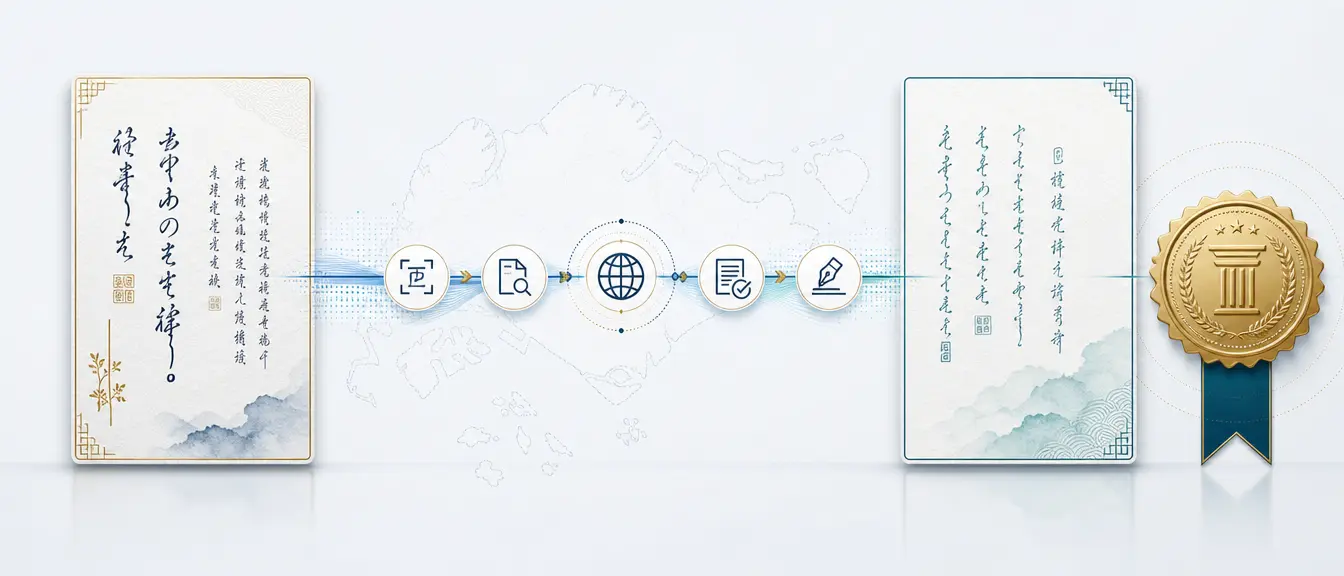
Certified translation in Singapore is a human translation of a non-English document into English accompanied by a certification statement; ICA's Guide to Applying for Permanent Residence states that documents not in English must be accompanied by a certified translation, so applicants should obtain a properly certified English translation before submitting documents to an agency, court, school or overseas authority.
What is certified translation in Singapore?
Certified translation in Singapore is a translated document accompanied by a signed statement confirming the translation's completeness and accuracy.
A certified document translation normally identifies the translator or translation provider, names the source and target languages, confirms that the translation is accurate and complete to the best of the translator's knowledge, and includes the date and signature. The exact wording can vary because receiving organisations may apply different submission requirements.
A certification statement does not automatically make a document notarised or legalised. Notarisation involves a notary public verifying a signature, identity or document-related act, while legalisation or apostille procedures authenticate documents for use in another jurisdiction. The receiving organisation determines whether certification alone is sufficient.
When do you need a certified English translation?
You need a certified English translation when the receiving organisation requires an English document with translator certification.
Singapore agencies may request certified translations for immigration, employment, vehicle, marriage, education and legal matters. ICA requires documents not in English to be accompanied by a certified translation for PR applications, and MOM requires certified translations of supporting documents for relevant Employment Pass applications.
ROM's required-documents guidance states that foreign documents must be translated and certified by a recognised translator for marriage registration. Singapore Courts may require certified translations of foreign-language documents for court filings, with the applicable format determined by the relevant practice directions.
LTA requirements can vary by document type. Overseas vehicle-related documents may require certified translation when submitted for a Singapore road or motoring matter, so applicants should check the requirement for the specific document before ordering.
Which documents can be certified translations?
Most personal, business and official documents can be translated into certified English when the receiving organisation accepts translator certification.
| Document category | Common examples | Typical Singapore use |
|---|---|---|
| Identity and civil-status documents | Birth certificates, marriage certificates, divorce certificates, death certificates | ICA, ROM, government applications and overseas authorities |
| Immigration documents | Residence records, police clearances, identity documents, family records | Singapore PR applications, pass applications and overseas immigration |
| Education documents | Diplomas, degrees, transcripts, certificates and academic records | Schools, universities, professional bodies and overseas admissions |
| Employment documents | Employment letters, reference letters, payslips and professional certificates | MOM applications, employers and professional registration |
| Corporate documents | Company extracts, incorporation documents, contracts and board resolutions | ACRA-related matters, banks, commercial transactions and overseas use |
| Legal documents | Affidavits, court exhibits, powers of attorney and judgments | Singapore Courts and foreign legal proceedings |
| Vehicle documents | Registration certificates, ownership records and foreign licences | LTA-related vehicle and motoring matters |
The receiving organisation may require the original, a copy, a notarised copy or additional legalisation alongside the certified translation. A certified translation provider can translate the document, but the provider cannot decide whether the receiving organisation will accept a particular format.
What does a translation with certification statement include?
A translation with certification statement includes the translated text and a signed declaration connecting the translation to the source document.
A practical certification statement usually includes:
- The translator's name or the translation company's name.
- The source language and target language.
- A declaration that the translation is accurate and complete to the best of the translator's knowledge and ability.
- The translator's or authorised representative's signature.
- The certification date.
- Contact or business details where required by the receiving organisation.
The certification statement should identify the source document clearly without changing names, dates, registration numbers or other identifying details. Names and numbers should normally follow the source document and any instructions issued by the receiving organisation.
How does certified document translation work in Singapore?
Certified document translation follows a document review, human translation, quality check and certification process.
- Identify the receiving organisation. Confirm whether the document is for ICA, MOM, LTA, ROM, a Singapore court, a school, an employer or an overseas authority because each organisation can set its own requirements.
- Check the source document. Provide a clear scan or photograph showing every page, stamp, seal, handwritten note and marginal entry that must appear in the translation.
- Confirm the certification format. Check whether the receiving organisation requires a certified translation, a recognised translator, notarisation, legalisation, an apostille or a specific form of declaration.
- Request a quotation. Translation pricing depends on language pair, word count, document complexity, formatting, urgency and any notarisation or legalisation requirement.
- Complete human translation. A qualified human translator translates the document while preserving names, dates, numbers, official terms, tables and relevant formatting.
- Perform quality review. The translation provider checks completeness, terminology, formatting and consistency against the source document before certification.
- Issue the certification statement. The translator or authorised provider signs and dates the statement confirming the translation's accuracy and completeness.
- Submit the complete package. Submit the certified translation with the source document and any required copy, notarisation or legalisation. The receiving organisation makes the final acceptance decision.
How much does certified translation cost in Singapore?
Certified translation pricing depends on the document, language pair, formatting and turnaround requirement.
Bablio offers transparent pricing from S$49 for eligible certified translation orders. The final price can change when a document contains multiple pages, complex tables, poor-quality scans, uncommon languages, handwritten content, urgent delivery requirements or additional certification-related services.
A quotation should state whether the price includes the translation, certification statement, proofreading, formatting, delivery and any applicable notarisation or legalisation. Comparing only a per-word rate can produce an incomplete cost comparison when providers include different services.
How long does certified translation take?
Certified translation turnaround depends on document length, language pair, formatting and urgency.
Bablio offers same-day turnaround for eligible certified translation orders. Same-day service depends on receiving complete, legible source documents early enough for the agreed production window and on the document meeting the provider's eligibility requirements.
Long documents, complex certificates, difficult scans, rare languages and documents requiring notarisation or legalisation can take longer. The receiving organisation's submission deadline should be checked before selecting a turnaround time.
What is the difference between certified, notarised and legalised translation?
Certified, notarised and legalised translations provide different forms of assurance and are not interchangeable.
| Service | What it usually confirms | When it may be required |
|---|---|---|
| Certified translation | The translator or provider declares that the translation is accurate and complete | ICA, MOM, ROM, schools, employers, agencies and courts where certification is requested |
| Notarised translation | A notary public verifies a signature, identity or related document act | Organisations that specifically request notarisation or a notarised declaration |
| Legalised or apostilled translation | An authority authenticates a signature, seal or public document for use in another jurisdiction | Overseas authorities that require apostille or legalisation |
The receiving organisation determines the required level of authentication. A notarised translation may still need legalisation for overseas use, while a certified translation may be sufficient for a particular Singapore application.
How can you make sure a certified translation is accepted?
You improve acceptance prospects by matching the translation and certification format to the receiving organisation's current instructions.
Check the submission checklist before translation, confirm whether the organisation recognises translator certification, and ask whether the source document also needs notarisation or legalisation. Provide every page and visible mark so the certified translation does not omit information that appears on the source.
Bablio formats certified translations for explicit acceptance by ICA, MOM, LTA, ROM and the courts, subject to the receiving organisation's requirements and final review. Bablio uses 100% human translation for certified document translation. Approval or acceptance is not guaranteed because the receiving organisation retains discretion over submitted documents.
How should businesses order certified translation services in Singapore?
Businesses should provide the document purpose, destination authority, language pair and required deadline before requesting certified translation services in Singapore.
A business order should specify whether the translation is for a contract, company record, employment matter, bank, regulator, court or overseas authority. The provider can then preserve corporate names, registration numbers, signatures, seals, tables and defined terms consistently across the translated document.
Businesses should also decide whether they need a single certified document or a terminology-consistent batch of documents. A shared glossary and reference translation can reduce inconsistencies across employment, corporate and legal documents.
What should individuals check before submitting a certified translation?
Individuals should check names, dates, document numbers, stamps, signatures and certification details before submission.
The translated document should correspond to the complete source document, including pages with no substantive text but with stamps, seals or annotations. Applicants should verify that the certification statement is signed and dated and that the stated source and target languages are correct.
Applicants should retain the source document, certified translation and proof of delivery together. Applicants should follow the receiving organisation's latest checklist if the checklist differs from a general translation provider's instructions.
What questions should you ask before ordering certified translation?
The most useful questions concern acceptance, certification scope, price, turnaround and additional authentication.
Ask whether the provider offers certified English translation for the specific source language, whether the certification statement is included, whether the complete document will be translated, whether the quoted price includes formatting and delivery, and whether same-day turnaround is available for the document type.
Ask the receiving organisation whether it requires a recognised translator, notarisation, legalisation, an apostille, a physical hard copy or a particular certification wording. This check prevents ordering a service that does not match the submission requirement.
What are the common questions about certified translation in Singapore?
Certified translation requirements depend on the receiving organisation and the document's intended use.
Does certified translation mean notarised translation?
No. Certified translation contains a translator's certification statement, while notarised translation involves a notary public and may be separately required.
Can a certified translation be used for an ICA application?
ICA requires documents not in English to be accompanied by a certified translation for PR applications. Applicants should follow the current ICA document checklist.
Can a certified translation be used for MOM?
MOM requires certified translations of supporting documents for relevant Employment Pass applications. Applicants should check the current MOM requirements for the specific pass application.
Does ROM accept certified document translation?
ROM's required-documents guidance states that foreign documents must be translated and certified by a recognised translator for marriage registration.
Can a certified translation be used in Singapore Courts?
Singapore Courts may require certified translations of foreign-language documents for court filings. The applicable practice directions determine the required format.
How much does certified translation cost?
Bablio's transparent pricing starts from S$49 for eligible certified translation orders, while the final cost depends on the document and requested service.
Can certified translation be completed on the same day?
Bablio offers same-day turnaround for eligible orders. Turnaround varies according to document length, language, formatting and order time.
What is a certification statement?
A certification statement is a signed declaration that identifies the source and target languages and confirms that the translation is accurate and complete to the best of the translator's knowledge and ability.
Can a translation provider guarantee acceptance?
No. The receiving organisation makes the final decision about whether a translation satisfies its current requirements.