
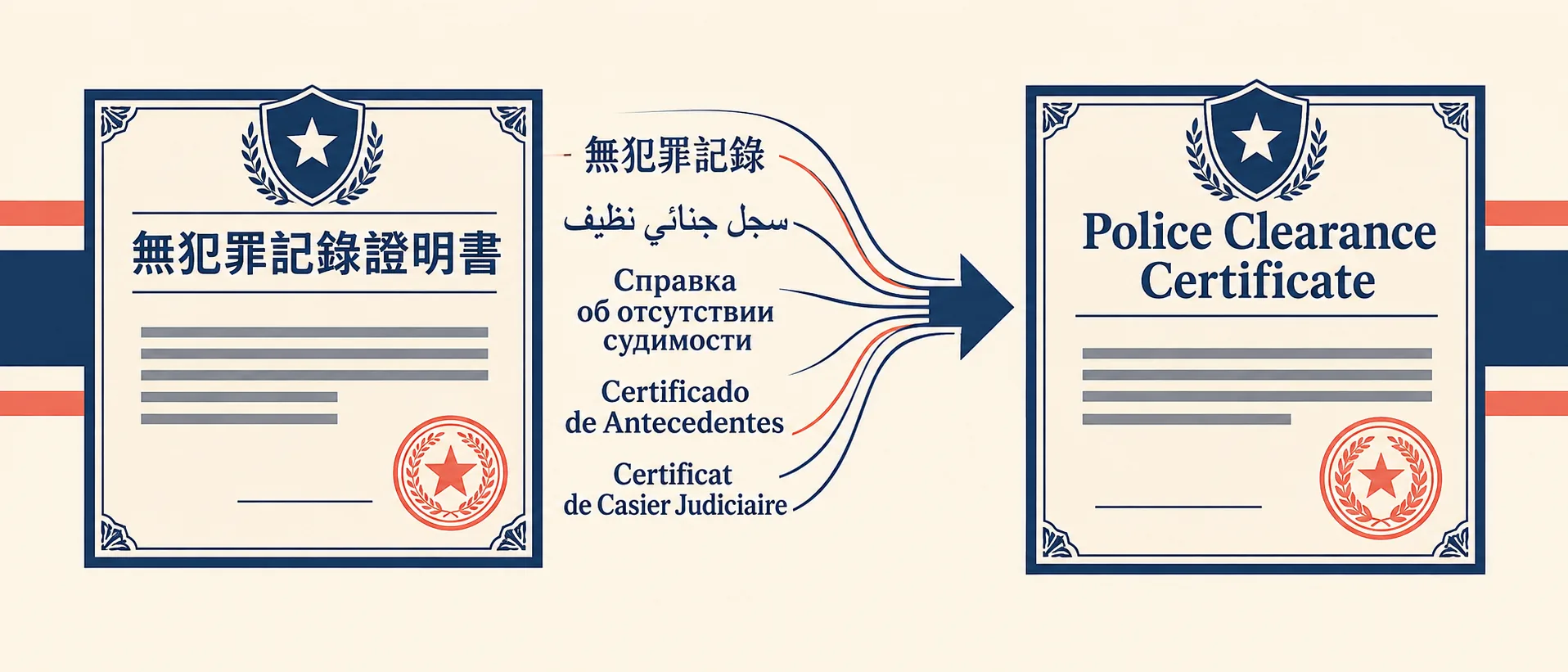
Police clearance certificate translation in Singapore is the complete English rendering of a foreign police certificate, and ICA maintains official Translation of Documents guidance for non-English supporting documents.[2] A foreign police certificate written wholly or partly in another language should be translated according to the instructions of the organisation handling the immigration, employment, study or legal application. Applicants should translate the entire document, preserve its original structure and confirm whether certification or notarisation is required. For general requirements beyond police certificates, see the Bablio guide to certified translation in Singapore.
What is a police clearance certificate translation?
A police clearance certificate translation is a complete English version of a police certificate, criminal-record certificate or equivalent document issued in another language.
A police certificate usually records whether the named person has a criminal record within the issuing authority’s jurisdiction. The translated version allows a Singapore authority, employer, educational institution or other receiving organisation to assess the document without relying on the applicant’s own interpretation.
A complete criminal record translation covers all visible content. Names, identification numbers, dates, headings, offence descriptions, search results, official remarks, stamps, seals, signatures and handwritten annotations should appear in the translation.
A translator should identify unreadable or obscured text rather than guessing. A note such as “[illegible]” or “[stamp]” makes the limitation clear and preserves the relationship between the translation and the source document.
When is police clearance translation needed in Singapore?
Police clearance translation is needed when a receiving organisation requests a police certificate and the certificate contains content that its reviewing officers cannot assess in English.
Immigration applications may require police or criminal-record documents in particular circumstances. Employment screening, professional licensing, university admission, visa applications for other countries and court proceedings may also involve police certificates.
The receiving organisation’s request controls the submission. An applicant should check the current application checklist, follow any case-specific instructions and avoid assuming that one authority’s translation rules automatically apply to another authority.
An English police certificate may still require translation when stamps, annotations or attachments appear in another language. A partial translation can prevent a reviewer from determining whether those additions affect the certificate’s meaning.
What information must the criminal record translation include?
A criminal record translation should reproduce every meaningful element of the source certificate without adding, omitting or interpreting information.
| Source element | What the English translation should show | Common risk |
|---|---|---|
| Document title | The translated title of the police certificate or criminal-record document | Using a generic title that hides the certificate type |
| Personal particulars | Full name, aliases, date of birth, nationality and identification details | Spelling that differs from the passport |
| Issuing authority | The translated name of the police force, ministry, court or public agency | Omitting the issuing body |
| Record result | The full result, including qualifying language and jurisdictional limits | Reducing a detailed result to “clear” or “no record” |
| Offence information | Offence names, legal references, dates, outcomes and penalties shown in the source | Summarising or interpreting the offence |
| Dates | Issue dates, search periods, validity dates and other dates in a clear format | Reversing day and month |
| Stamps and seals | Translated wording plus an indication that a stamp or seal appears | Removing a stamp because it looks decorative |
| Signatures | The signatory’s printed name and title, where visible, plus a signature label | Treating a signature block as irrelevant |
| Handwritten notes | A translation of legible notes or a clear unreadable-text label | Ignoring later annotations |
| Page structure | Matching headings, tables, reference numbers and page order | Producing text that cannot be compared with the original |
Transliteration requires particular care. The translator should use the passport spelling supplied by the applicant where appropriate and should flag material variations rather than silently changing the source.
Does a police certificate translation need certification or notarisation?
Certification or notarisation depends on the receiving authority’s instructions; translation, certification and notarisation are separate steps.
A certified translation normally includes a declaration identifying the translator or translation provider and confirming that the English text accurately and completely represents the source document. The certification package may also include the translation date, signature and provider details.
Notarisation involves a Notary Public and should be arranged only when the application instructions require it. The Singapore Ministry of Law provides information about notarisation and maintains a list of Notaries Public.[3]
Authentication of the original document is also separate from translation. An authority may ask for authentication, legalisation or another verification process in addition to an English translation, so applicants should identify each requested step before ordering the service.
ICA publishes a dedicated Translation of Documents page, but applicants should also read the instructions for the specific ICA application being submitted.[2] A translation format accepted for one process should not be treated as universal approval for every Singapore or overseas application.
How much does police clearance certificate translation in Singapore cost?
Bablio lists police clearance certificate translation from S$68, although the final price can vary with language, length, legibility and additional certification requirements.[1]
Bablio states that its police clearance translation service uses 100% human translation and offers same-day turnaround. Bablio also states that documents are formatted for acceptance by ICA, MOM, LTA, ROM and the courts.[1] The receiving organisation makes the final decision on whether a submitted document satisfies its requirements.
A short, clearly scanned, one-page certificate is usually simpler to quote than a multi-page criminal-record extract containing tables, legal terminology or handwritten entries. Notarisation and other authentication procedures may add separate fees and processing time.
Applicants should provide every page when requesting a quote. A price based on an incomplete scan may change if the reverse side, attachments or additional stamps also require translation.
How long does police clearance translation take?
A clear, short police certificate may qualify for same-day translation, while complex or poorly legible records can take longer.
Bablio lists same-day turnaround for its police clearance certificate translation service.[1] Availability can depend on the language pair, document length, translator capacity, source quality and requested certification steps.
Notarisation should be included in the timetable from the beginning when it is required. A translation deadline does not automatically include the time needed to arrange a Notary Public or complete any separate document-authentication procedure.
Applicants should also reserve time to review names, dates and identification numbers before submission. A same-day service provides limited value if a mismatch with the passport is discovered after the application deadline.
What documents are needed for a police certificate translation?
The translator needs a complete and legible copy of the police certificate plus any reference material required to reproduce personal details accurately.
Applicants should normally provide:
- A colour scan or clear photograph of every page of the police certificate.
- Images of the front and reverse sides when either side contains text, stamps or seals.
- A passport bio-data page or the preferred English spelling of the applicant’s name.
- The receiving authority’s translation, certification or notarisation instructions.
- The submission deadline and requested delivery format.
- Earlier translations of related documents when consistent terminology is important.
Sensitive information should remain visible when it forms part of the document under review. Applicants who redact identification numbers, offence information or authority references should first confirm that the receiving organisation permits redaction.
A low-resolution messaging-app image can obscure diacritics, serial numbers and small stamp text. A direct scan or full-resolution image reduces the risk of an inaccurate or incomplete translation.
How do you obtain a police clearance certificate translation?
Applicants can obtain a submission-ready translation by checking the receiving authority’s rules before sending the complete certificate to a professional translator.
- Confirm the destination and purpose. Identify whether the police certificate is for ICA, MOM, a university, an employer, a court or another organisation.
- Read the current instructions. Check whether the receiving organisation asks for a translation, certified translation, notarised translation or authentication of the original document.
- Scan the complete certificate. Capture every page, reverse side, stamp, seal, signature and attachment in colour at a readable resolution.
- Provide spelling references. Supply the passport spelling of the applicant’s name and clarify any known aliases or transliteration differences.
- Request the correct service. State the language, deadline, delivery format and any certification or notarisation requirement when obtaining the quote.
- Review the translated details. Compare names, passport numbers, certificate references, dates and record results against the source.
- Keep the documents together. Retain the source certificate, English translation and any certification or notarisation pages as one submission set.
- Follow upload or filing limits. Combine, compress or separate the files only as directed by the receiving organisation.
Applicants seeking broader information about source-document preparation can also consult the guide to document notarisation in Singapore.
How do requirements differ between receiving organisations?
Each receiving organisation applies its own document checklist, so applicants should verify the required translation format for the specific submission.
| Receiving organisation | What the applicant should verify | Practical preparation |
|---|---|---|
| ICA | The relevant application checklist and ICA’s current translation guidance | Keep the source document and translation together |
| MOM | The instructions shown in the relevant pass application or case-specific request | Confirm whether certification is expressly requested |
| University or school | The admissions office’s language and document-verification rules | Ask whether digital copies are sufficient |
| Employer or screening provider | The background-screening scope and accepted file format | Preserve all pages and record-result wording |
| Court or legal representative | Filing directions and any notarisation requirement | Maintain page order and formal terminology |
| Overseas embassy or immigration authority | Country-specific translation and authentication rules | Avoid assuming that Singapore requirements apply overseas |
A police certificate can pass through more than one organisation. An applicant using the same document for separate applications should check each organisation’s rules rather than relying on the first submission.
Why are police certificate translations delayed or rejected?
Police certificate translations are commonly delayed when the submission is incomplete, inconsistent or prepared under the wrong certification standard.
Name mismatches create avoidable uncertainty. A translation that uses a different English spelling from the passport should explain the source spelling or adopt the confirmed passport spelling without concealing the original text.
Partial translation creates another risk. Stamps, seals, handwritten remarks and reverse-side text can affect how the receiving organisation assesses authenticity and completeness.
Unreadable scans prevent accurate work. A translator should not guess blurred dates, certificate numbers or offence descriptions, and the receiving organisation may request a clearer copy.
Wrong service selection can also cause delay. A standard translation may need to be reissued if the application required certification or notarisation from the beginning.
Expired or unsuitable source documents cannot be corrected through translation. Translation reproduces the certificate’s contents; translation does not extend validity, alter the issuing jurisdiction or replace a newly requested police check.
What does a typical police clearance translation case look like?
A typical case involves a foreign-language police certificate, an English-language application and a deadline that leaves little room for correction.
An illustrative applicant received a two-page police certificate containing a record result on the first page and an official stamp on the reverse side. The applicant initially supplied only the front page and requested a standard English translation.
The receiving organisation’s instructions required a complete translated set. The translator requested the reverse side, matched the applicant’s name to the passport spelling, translated the stamp text and retained the original certificate number and date format.
The completed package contained the source pages, the corresponding English pages and the required certification statement. Early confirmation of the complete document prevented the reverse-side stamp from becoming a late-stage submission issue.