
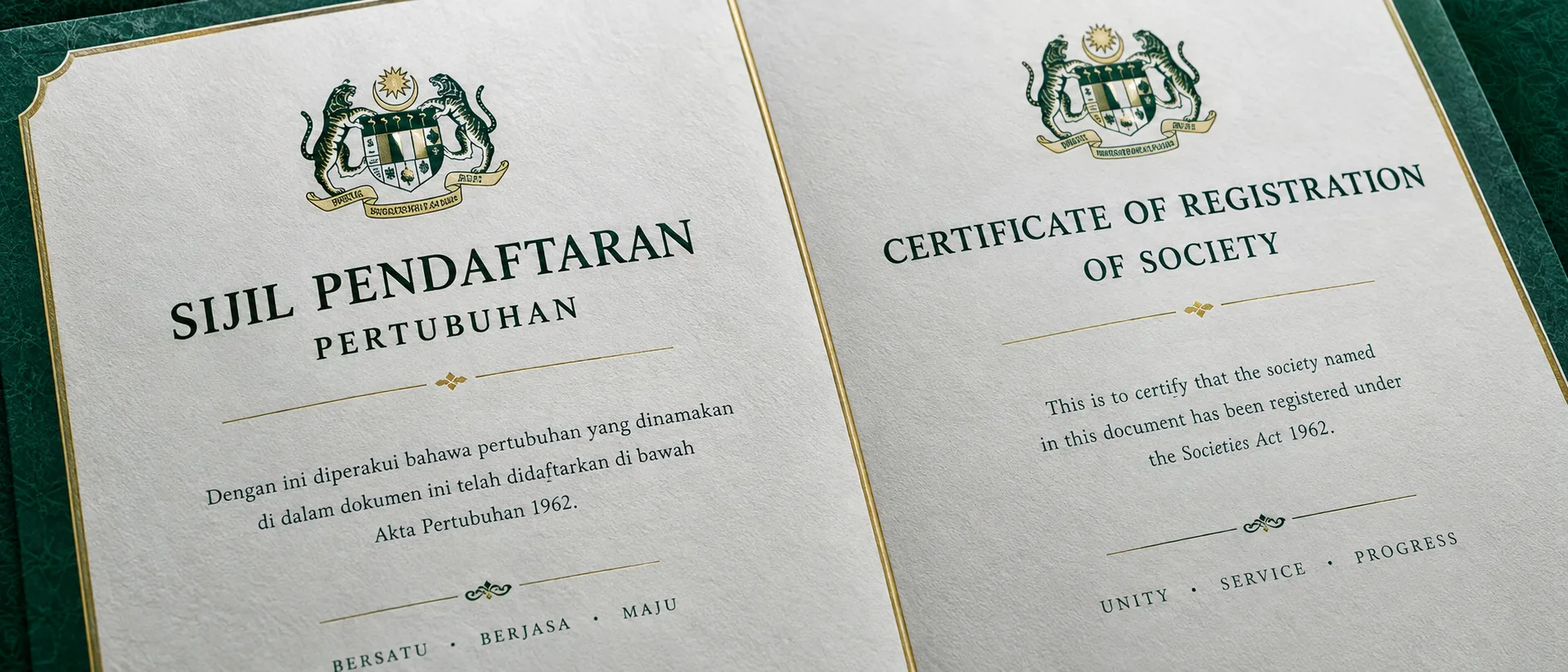
Malaysian to English certified translation converts a Malaysian document into English and adds a translator’s certification for submission to a Singapore authority, court, employer or institution. ICA requires documents not in English to be translated into English for Singapore PR applications.[1] A suitable translation should reproduce the complete document, preserve names and dates accurately, identify the translator and include a signed certification statement. The term “Malaysian” describes the document’s country of origin rather than a single language, so the translator must first confirm whether the source is in Bahasa Malaysia, Chinese, Tamil or another language.
What is a Malaysian to English certified translation?
A Malaysian to English certified translation is an English translation of a Malaysian document accompanied by a formal statement confirming the translation’s accuracy and completeness.
A certification statement normally identifies the source and target languages, confirms that the translation is complete and accurate, and records the translator’s name, signature and date. The resulting package allows the recipient to connect the English text with the source document.
A Malaysian document does not necessarily contain Bahasa Malaysia. Malaysian birth certificates, academic records, contracts and court papers may contain Bahasa Malaysia, English, Chinese, Tamil or several languages on the same page. A translation provider should inspect every page before confirming the language pair and price.
People searching for a Malaysian translator to English commonly mean a professional who can translate Malaysian documents into English. A precise order should identify the actual source language, such as Bahasa Malaysia to English.
When is certified Malaysia document translation needed?
Certified Malaysia document translation is needed when a receiving organisation requires an English version of a document issued or written in another language.
Singapore authorities apply their own submission instructions. ICA requires English translations for non-English documents submitted with Singapore PR applications,[1] while ROM publishes separate guidance for documents used in marriage-related procedures.[2] LTA forms may also require English translations when foreign vehicle documents are involved.[3]
| Submission purpose | Malaysian documents commonly involved | Point to check |
|---|---|---|
| Singapore PR or citizenship | Birth certificates, marriage certificates, education records and identity documents | ICA instructions determine the required translation and supporting files. ICA maintains separate citizenship application guidance.[4] |
| Employment Pass or other work matters | Education certificates, employment records and civil-status documents | MOM or the submitting employer determines the required format. |
| Marriage registration | Birth certificates, divorce documents and previous marriage records | ROM instructions determine whether translation or additional authentication is required. |
| Vehicle registration | Registration records, ownership documents and technical records | LTA instructions determine which foreign documents require English translation. |
| Court or legal use | Judgments, affidavits, agreements and correspondence | The court, lawyer or procedural direction determines the evidential format. |
| Education or employment | Transcripts, diplomas, reference letters and professional certificates | The school, employer or assessment body determines whether certification is sufficient. |
Bablio states that its service provides explicit acceptance by ICA, MOM, LTA, ROM and the courts — documents formatted to be accepted the first time. Acceptance remains dependent on submitting the correct document type and complying with the receiving organisation’s current instructions.
Which Malaysian documents can be translated into English?
Most legible Malaysian civil, academic, corporate, legal and vehicle documents can be translated into English.
Common civil documents include Malaysian birth certificates, marriage certificates, divorce documents, death certificates, adoption records and identity-related records. Common academic documents include diplomas, degree certificates, transcripts, school records and professional qualifications.
Corporate and employment documents include SSM records, employment letters, payslips, tax records, contracts, board resolutions and business correspondence. Legal documents include judgments, statutory declarations, affidavits and agreements.
Vehicle-related requests may include Malaysian registration cards, ownership records, inspection papers and supporting technical documents. The translator should receive all stamps, endorsements, reverse pages and attached schedules because omitted content can make the translation incomplete.
What should a certified Bahasa Malaysia translation include?
A certified Bahasa Malaysia translation should include the full English text, a copy of the source document and a signed certification statement.
The English version should preserve the source document’s headings, field order and page structure where practical. Names, identity numbers, dates, reference numbers, stamps and handwritten annotations should remain traceable to the original.
Unclear or unreadable text should be identified rather than guessed. Official seals, signatures and logos should be described where their presence matters, but the translation should not imitate an official Malaysian document or present itself as a newly issued original.
The certification page should identify the language pair and connect the declaration to the translated pages. Page numbering and consistent file naming make the package easier for an authority or case officer to review.
How do you obtain a Malaysian to English certified translation?
The process involves confirming the recipient’s rules, supplying clear source files, approving the quotation and checking the completed certified package.
- Confirm the receiving organisation. Identify whether the translation is for ICA, MOM, LTA, ROM, a court, a school, an employer or another recipient because each organisation may set different submission rules.
- Check the service level. Determine whether the recipient asks for certification only, notarisation, legalisation or another form of authentication.
- Scan every relevant page. Provide clear colour images of the front, reverse, stamps, endorsements and attachments without cropped edges.
- Identify the source language. State whether the document contains Bahasa Malaysia, Chinese, Tamil, English or multiple languages.
- Confirm names and spellings. Supply the passport spelling of personal names when transliteration or inconsistent Romanisation could create a mismatch.
- Review the quotation. Check the price, turnaround, delivery format and whether notarisation or hard-copy delivery is included.
- Check the draft or completed translation. Compare names, dates, document numbers and issuing authorities with the source before submission.
- Submit the complete package. Keep the source copy, translation and certification together unless the receiving organisation gives different instructions.
How much does Malaysian to English certified translation cost?
Bablio lists Malaysian to English certified translation from S$68.
The final price depends on page count, word count, language, legibility, document complexity, formatting and the required service level. Notarisation, legalisation, urgent work, courier delivery and extra certified copies can affect the total.
A quotation should state whether the fee covers translation, certification, formatting and digital delivery. A low per-page price may not include certification or may apply only to short, standard documents.
How long does a Malaysian document translation take?
Bablio offers same-day turnaround for eligible Malaysian document translations.
Same-day completion depends on document length, source quality, language availability, order time and the need for notarisation or legalisation. Multi-page legal records, handwritten documents and mixed-language files can require additional time.
Submission deadlines should allow time for a spelling and number check. Authority processing begins separately after the completed translation is submitted.
What is the difference between certified translation, notarisation and legalisation?
Certified translation confirms the translation, notarisation verifies a signature or declaration, and legalisation authenticates a public document for use across jurisdictions.
| Service | Primary function | When to use it |
|---|---|---|
| Certified translation | A translator or translation provider certifies that the English translation is complete and accurate. | Use certified translation when the recipient asks for a certified English version. |
| Notarisation | A Notary Public performs the required notarial act for the document or certification. | Use notarisation only when the recipient expressly requires a notarised package. |
| Legalisation or authentication | The relevant authority authenticates the signature or capacity attached to a public or notarised document. | Use legalisation or authentication when the destination country or recipient requires it. |
One service does not automatically include the others. A certified translation should not be ordered with notarisation or legalisation unless the submission instructions require the additional step.
Why can a Malaysian document translation be rejected?
A receiving organisation can reject or query a translation when the package is incomplete, inaccurate, illegible or inconsistent with its instructions.
Common problems include missing reverse pages, omitted stamps, cropped scans, incorrect identity numbers, inconsistent name spellings and unlabelled handwritten text. A translation may also fail a procedural check when the recipient requested notarisation but received certification only.
Machine-generated text can introduce errors in official titles, abbreviations, dates and legal terminology. Bablio uses 100% human translation for its Malaysian to English certified translation service, which supports contextual review and consistent formatting.
Outdated instructions create another risk. Applicants should check the receiving organisation’s current document checklist before ordering and again before submitting.
How does a Malaysian birth certificate translation work in practice?
A Malaysian birth certificate for a Singapore PR submission should be translated from its actual source language, checked against the applicant’s identity records and packaged with certification.
An illustrative applicant has a Malaysian birth certificate containing Bahasa Malaysia, an official stamp and handwritten annotations. The applicant provides a complete colour scan and confirms the passport spelling of every personal name.
The translator reproduces the certificate’s fields in English, translates the annotations, identifies the stamp and retains the original dates and reference numbers. The certified package includes the source copy, English translation and certification statement.
The applicant compares the finished translation with the passport and application form before uploading it. The review catches spelling discrepancies before submission rather than after an authority raises a clarification request.
How should you choose a Malaysian translator to English?
A suitable Malaysian translator to English should provide human translation, certification, transparent pricing and formatting appropriate for the intended recipient.
Language competence should match the actual source document. A Bahasa Malaysia translation requires Bahasa Malaysia expertise, while Chinese or Tamil content requires a translator qualified for that language pair.
The provider should explain whether the quotation includes certification, formatting, revisions and digital delivery. The provider should also identify whether notarisation or legalisation is available when the recipient requires it.
Bablio’s certified translation service covers the general certification process, while its dedicated Malaysian to English certified translation service addresses Malaysian documents. Bablio lists prices from S$68, same-day turnaround and 100% human translation.