
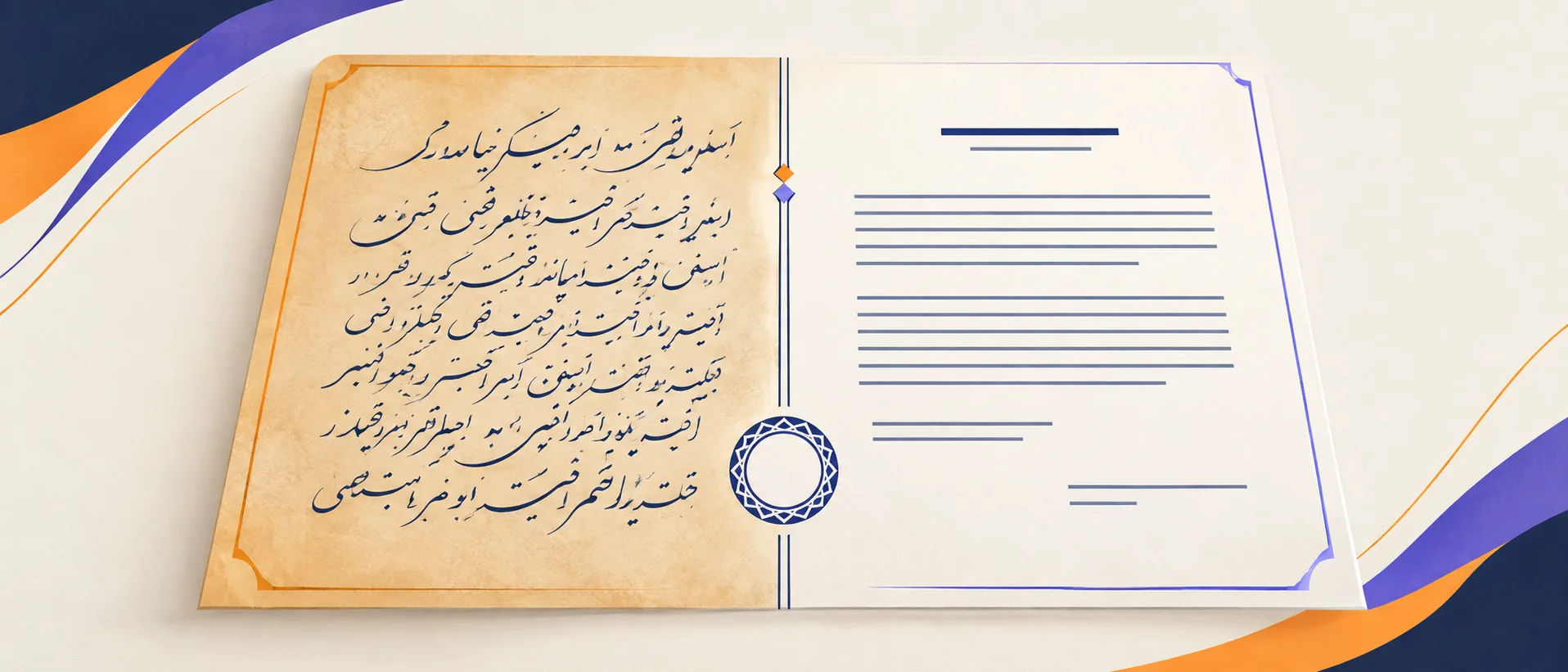
Malay to English certified translation is a complete English rendering of a Malay document accompanied by a formal certification of accuracy. ICA requires applicants uploading Singapore PR documents to provide certified true copies of the original documents and “official translations (for documents in languages other than English)”.[1] A Malay document therefore requires an English translation when that document forms part of a Singapore PR submission. The correct certification route depends on the receiving authority, so applicants should check the current instructions for the specific transaction before ordering.
What is a Malay to English certified translation?
A Malay to English certified translation reproduces the complete meaning and visible content of a Malay document in English and includes a statement certifying the translation’s accuracy.
The translated document should preserve names, dates, reference numbers, stamps, headings, signatures and handwritten annotations where they are legible. The translator should mark seals, logos or unclear text appropriately instead of omitting them without explanation.
The certification statement normally identifies the source and target languages, confirms that the translation is accurate and complete, and provides information about the translator or translation provider. The receiving authority determines whether that certification format is sufficient.
A regular Malay translation Singapore residents use for personal understanding does not automatically satisfy an official submission requirement. An official application may require certification, notarisation, embassy attestation or a certified true copy in addition to the translated text.
When is a certified Malay translation required in Singapore?
A certified Malay translation is generally required when a receiving authority asks for an English version of an official Malay document.
| Submission context | Malay documents that may be relevant | Action before ordering |
|---|---|---|
| Singapore PR application | Birth, marriage, education, employment or civil-status records | Check the current ICA document checklist and accepted translation routes |
| Work pass matter | Qualifications, employment records or supporting civil documents | Check the instructions for the specific MOM pass or transaction |
| Driving or vehicle matter | Driving licence, registration record or related certificate | Check the current LTA or Traffic Police submission instructions |
| Marriage-related transaction | Birth, divorce, death or marital-status documents | Check the applicable ROM procedure and document list |
| Court or legal matter | Agreements, correspondence, certificates or evidential records | Obtain instructions from the lawyer, court or filing party |
| Banking or commercial matter | Company, income, ownership or identity records | Ask the recipient which certification format it accepts |
A document’s language alone does not determine the complete process. The receiving authority, application type and intended legal use determine whether a standard certification, notarisation or additional authentication is required.
What does ICA accept for translated Singapore PR documents?
ICA accepts specified embassy, notarial and attested translation routes for Singapore PR supporting documents.
ICA states that applicants must provide certified true copies of original documents and official translations for documents in languages other than English.[1] ICA accepts translations provided by the embassy of the country or place that issued the document, translations provided by a notary public in Singapore or the issuing country or place, and privately translated documents that have been attested by the issuing country’s embassy or notarised by a notary public in Singapore or the issuing country or place.[1]
ICA does not endorse any private translation companies or entities, and insufficient documentation may result in non-acceptance of an application.[1] A translation provider can prepare documents around ICA’s published routes, but no private provider can guarantee that ICA will accept a submission.
Applicants should review the current ICA checklist for their Singapore PR category. The checklist determines which original records, certified true copies and translations belong in the application.
Which Malay documents are commonly translated into English?
Civil, education, employment, financial and vehicle records are common subjects of Malay document translation.
| Document category | Common examples | Details that require careful checking |
|---|---|---|
| Identity and civil status | Birth certificates, marriage certificates and identity records | Names, identification numbers, dates and relationships |
| Education | Diplomas, certificates, transcripts and letters | Institution names, qualifications, grades and dates |
| Employment | Employment letters, payslips and service records | Employer details, job titles, salary figures and periods |
| Financial | Bank letters, statements and income records | Account references, currencies, totals and transaction dates |
| Business | Registration records, agreements and company letters | Entity names, registration numbers and authorised signatories |
| Driving and vehicles | Driving licences and vehicle records | Licence classes, validity dates and registration particulars |
| Legal | Declarations, court documents and correspondence | Case references, formal terminology and procedural wording |
A translator should reproduce every material part of the source document. Missing reverse pages, cropped stamps and unreadable scans can delay the work or produce an incomplete submission package.
What is the difference between certification, notarisation and a certified true copy?
Certification addresses the translation, notarisation formalises a signature or document before a notary public, and a certified true copy confirms that a copy matches an original.
| Process | What the process addresses | Typical output |
|---|---|---|
| Certified translation | Accuracy and completeness of the English translation | Translation with a signed or issued certification statement |
| Notarised translation | Formal notarisation required by the receiving body | Translation package completed through a notary public |
| Certified true copy | Fidelity of a copied source document to the original | Copy bearing the appropriate certification |
| Embassy attestation | Authentication or attestation through an embassy | Document package bearing the relevant embassy action |
A certified translation and a certified true copy serve different purposes. An application can require both an acceptable copy of the original Malay document and an official English translation.
Notarisation is not an automatic feature of every certified translation. Applicants should identify the receiving authority’s exact route before paying for extra processing.
How does the Malay translation process work?
The process moves from requirement checking and document review to translation, quality control, certification and delivery.
- Identify the receiving authority. The applicant records the agency, institution or court receiving the translated document.
- Check the submission instructions. The applicant confirms whether the authority requires certification, notarisation, a certified true copy or embassy involvement.
- Prepare the full document. The applicant supplies every page, including blank reverse pages when stamps or endorsements may appear there.
- Submit a clear scan. The image should show all edges, stamps, signatures, numbers and handwritten notes.
- Confirm names and preferred spellings. The applicant provides passport spellings or existing English-language records when names could be rendered in more than one way.
- Translate the complete content. The translator reproduces the Malay text and identifies visible non-text elements.
- Perform quality control. The reviewer checks names, dates, figures, document references and formatting against the source.
- Add the required certification. The provider applies the certification format selected for the intended submission.
- Complete additional formalities. A notary public or embassy handles any separately required notarisation or attestation.
- Deliver and review the package. The applicant checks the source, translation and certification pages before submission.
What information should you provide to the translator?
The translator needs the complete document, its intended use, the receiving authority and any official English spellings already used for names or institutions.
A clear colour scan provides more context than a cropped photograph. The scan should preserve page edges, embossed seals, stamps, signatures and handwritten additions.
The intended use affects the required certification route. A translation prepared for general reference may differ from a package intended for ICA, MOM, LTA, ROM or court submission.
Existing passport spellings help the translator maintain consistency. A name should match the applicant’s identity records where the underlying documents refer to the same person.
Earlier translations can provide useful terminology, but the translator should still work from the source document. An old English version may contain omissions, outdated spellings or formatting that does not suit the new submission.
How much does Malay to English certified translation cost?
The price depends on page count, word volume, legibility, formatting and any notarisation or certified-copy requirements.
Bablio may quote straightforward Malay to English certified translation from S$49, subject to the current service terms and document review.[2] Complex layouts, handwritten content, urgent processing and additional formalities can change the final price.
A useful quotation should separate translation, certification, notarisation, certified true copying, delivery and urgent-processing charges. The separation allows the applicant to compare equivalent scopes rather than headline prices.
Applicants should submit the complete document for pricing. A partial screenshot can conceal reverse pages, stamps or dense sections that affect the work required.
How long does Malay to English certified translation take?
A short and legible document may be suitable for same-day translation, while complex documents and additional formalities require more time.
Bablio may offer same-day turnaround for eligible documents, subject to capacity, cut-off times and the required certification route.[2] Turnaround remains dependent on page count, source quality, formatting complexity and reviewer availability.
Notarisation and embassy procedures can extend the overall timeline beyond the translation stage. Applicants should disclose the submission deadline and destination at the quotation stage.
Urgent work should still include quality control. Names, dates, figures and reference numbers require careful comparison because small errors can create inconsistencies across an official application.
Why does human translation matter for official Malay documents?
Human translation provides contextual review of names, legal terms, abbreviations, stamps and document structure that automated output may mishandle.
Official records often contain compact wording, institutional terminology and formatting that affects interpretation. A human translator can compare related fields and flag text that is obscured or genuinely ambiguous.
Machine-generated text can assist informal understanding, but automated output does not by itself supply the certification or formalities requested by a receiving authority. The submitted package must follow the authority’s stated document requirements.
Bablio describes its Malay document translation process as 100% human translation.[2] The provider’s quality review should still verify the final translation against every visible element of the source.
What errors commonly cause translation problems?
Incomplete scans, inconsistent names and the wrong certification route create the most avoidable problems.
| Problem | Why the problem matters | Preventive action |
|---|---|---|
| Cropped document | Missing text or seals can make the translation incomplete | Scan the whole page with visible edges |
| Missing reverse page | Endorsements or stamps may be omitted | Supply both sides of every document |
| Blurred image | Names and numbers can become uncertain | Use a high-resolution colour scan |
| Inconsistent name spelling | The translation may conflict with identity records | Supply the passport spelling in advance |
| Partial translation | The receiving body may expect all visible content | Include headings, stamps and annotations |
| Wrong certification route | A basic certificate may not meet the stated requirement | Check the destination’s instructions first |
| Late requirement check | Additional formalities may miss the deadline | Confirm notarisation or attestation before translation |
| Unreviewed figures | A single digit can change a date, amount or identifier | Compare every figure against the source |
Applicants should treat document preparation as part of the translation process. A complete source file gives the translator the best chance of producing a consistent package.
How should names, seals and handwritten text be translated?
Names should follow authoritative spellings, while seals and handwritten text should be translated or clearly identified according to their legibility.
Personal names should match the spelling used in the applicant’s passport or principal identity document where possible. Company and institution names should follow established English versions when reliable evidence is available.
A visible seal should appear in the translation as translated content or an explanatory notation. A translator should avoid inventing wording when a seal is too faint to read.
Handwritten notes require the same caution. Legible handwriting should be translated, while genuinely unreadable text should be marked as illegible rather than guessed.
Dates and numbers should receive a separate quality-control check. Similar-looking digits and unfamiliar date layouts can cause material inconsistencies.
How can you check a completed certified translation?
A final check should compare every name, date, number, page and certification element against the source and submission instructions.
- Count the pages. The source and translation package should cover the complete document.
- Compare names. Each personal and institutional name should follow the intended English spelling.
- Compare dates. Birth, marriage, issue and expiry dates should match the Malay source.
- Compare numbers. Identification, licence, registration, account and reference numbers should remain exact.
- Check stamps and notes. The translation should identify relevant seals, signatures and handwritten content.
- Read the certification. The certification statement should identify the relevant language pair and translation.
- Confirm additional formalities. The package should include required notarisation, certified true copies or attestation.
- Check the upload format. The files should comply with the receiving portal’s current file and document instructions.
A reviewer should resolve any discrepancy before submission. An applicant should never alter the certified translation independently because the resulting file may no longer match the provider’s certification.
What does an anonymised translation example look like?
An applicant can avoid repeat processing by confirming the accepted translation route before translating a Malay civil document.
An anonymised Singapore PR applicant held a Malay birth certificate containing a handwritten annotation and an embossed seal. The applicant initially supplied a cropped mobile photograph that omitted part of the page edge.
The translation provider requested a complete colour scan and the applicant’s passport spelling. The translator reproduced the printed content, identified the seal and translated the legible handwritten annotation.
The applicant selected a certification route after reviewing ICA’s published translation requirements. ICA accepts specified embassy, notarial and attested private-translation routes for Singapore PR documents.[1]
The completed package contained the full source copy, English translation and applicable certification materials. The example shows why document completeness and destination requirements should be settled before final delivery.
What should you know before ordering Malay to English certified translation?
Applicants should confirm the destination, certification route, deadline and complete page count before ordering.
Does every Malay document need certified translation?
A Malay document needs certified translation when the receiving authority or institution requires an official English version. Personal reference translations may not require certification.
Does ICA accept privately translated documents?
ICA accepts privately translated documents when the documents are attested by the embassy of the issuing country or place, or notarised by a notary public in Singapore or the issuing country or place.[1]
Does ICA endorse Bablio or another private translation company?
ICA does not endorse any private translation companies or entities.[1] ICA assesses submitted documents against its requirements.
Is a certified translation the same as a notarised translation?
A certified translation contains a statement about translation accuracy, while notarisation involves a notary public and serves a separate formal purpose.
Do I need to translate stamps and handwritten notes?
A complete translation should account for visible stamps and handwritten notes. Illegible content should be identified instead of guessed.
Can I submit a machine translation?
Machine output does not by itself provide the certification or formalities required for an official submission. The receiving authority’s current rules determine the acceptable format.
How much does Malay to English certified translation cost?
Bablio may quote eligible documents from S$49, subject to current pricing, document review and any additional formalities.[2]
Can a Malay document be translated on the same day?
A short, clear document may qualify for same-day turnaround, but timing varies with complexity, capacity and certification requirements.[2]
What file should I send for translation?
A complete, high-resolution colour scan showing every page edge, seal, signature and annotation provides the best source material.
Will an authority definitely accept a certified translation?
Acceptance is not guaranteed because the receiving authority assesses the entire document package under its current requirements.