
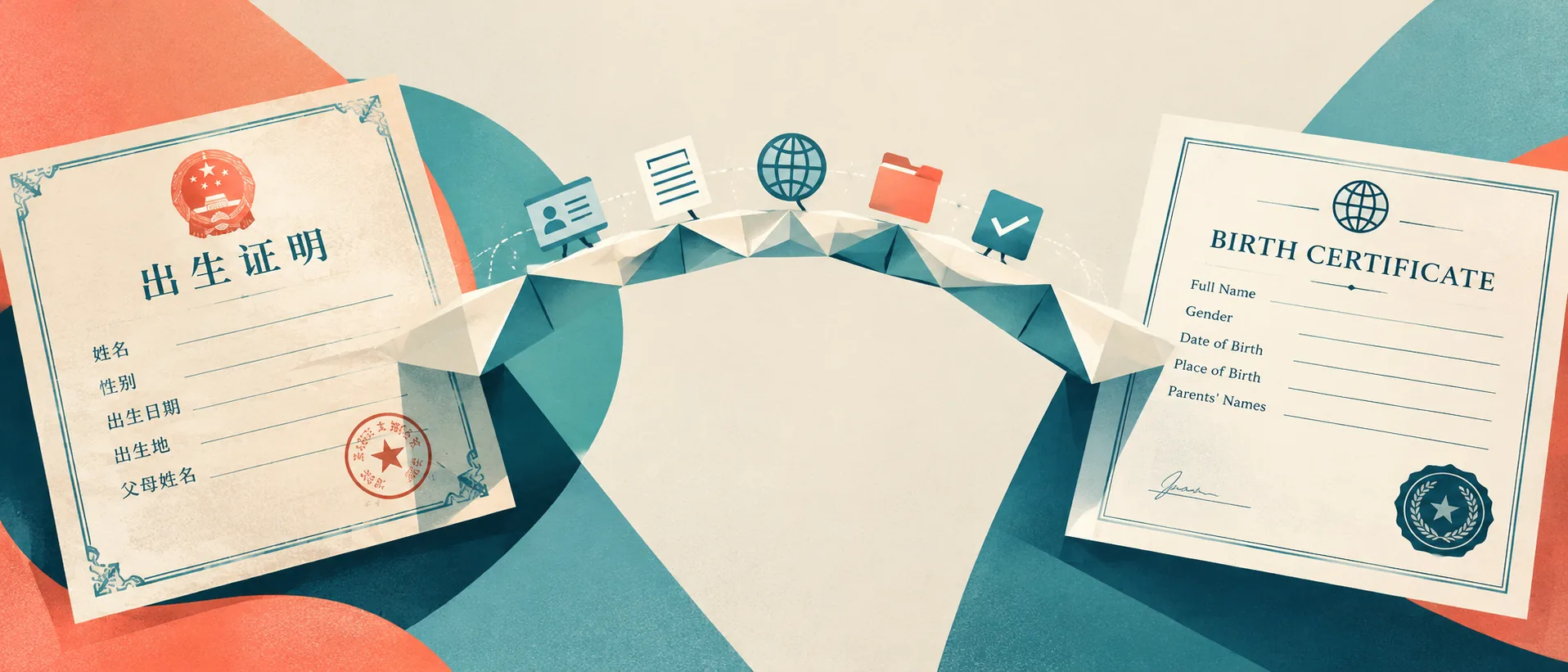
Birth certificate translation in Singapore converts a foreign-language birth record into English for official use, and ICA states that an official translation is required when a supporting document is not in English.[1] Applicants should submit a clear copy of the complete original certificate together with a faithful English translation and any certification required by the receiving authority. Bablio offers transparent pricing (from S$68), same-day turnaround, 100% human translation, and explicit acceptance by ICA, MOM, LTA, ROM and the courts — documents formatted to be accepted the first time. Approval or acceptance can still depend on the application, document quality and receiving authority’s instructions.
What is a birth certificate translation in Singapore?
A birth certificate translation is a complete English rendering of the names, dates, places, parent details, registration particulars, stamps, seals and annotations shown on a birth certificate issued in another language.
A birth cert translation should preserve the structure and meaning of the source record. Translators should transliterate names consistently with the applicant’s passport and identify stamps, handwritten notes or unreadable text rather than silently omitting them.
A translated birth certificate does not replace the original document. The original establishes the source record, while the translation allows an English-speaking authority to understand that record.
When does ICA require a birth certificate translation?
ICA requires an official translation when a document submitted for birth registration is not in English. ICA instructs applicants uploading birth-registration documents to provide certified true copies of the originals and official translations for documents in languages other than English.[1]
ICA accepts translations provided by the embassy of the country or place that issued the document, translations provided by a notary public in Singapore or the issuing country or place, and privately prepared translations that the issuing country’s embassy attests or a notary public notarises.[1]
ICA does not endorse private translation companies or entities, and ICA warns that insufficient documentation may result in non-acceptance or a request for additional documents.[1] Applicants should therefore check the instructions for the particular ICA application instead of assuming that every ICA submission follows an identical certification route.
ICA does not register births that occurred overseas. Parents of a child born overseas must obtain the birth certificate from the relevant authority in the country or place of birth.[1]
What does MOM require for a translated birth certificate?
MOM requires the original non-English document and its English translation to be uploaded together as one file for a Dependant’s Pass application. MOM permits applicants to approach a translation service provider for the translation.[2]
MOM requires an official birth certificate stating the parents’ names when an unmarried child under 21 is included in a Dependant’s Pass application.[2] A translation should therefore reproduce both parents’ names exactly as recorded and should use spellings consistent with the family’s passports and other supporting documents.
A combined upload should remain legible at normal viewing size. The original and translation should appear as separate, complete pages within the same PDF rather than as cropped images or a translation pasted over the source document.
Which documents and details should be prepared for birth cert translation?
Applicants should provide the complete birth certificate, passport spellings for the people named in it and the receiving authority’s submission instructions. A complete source file reduces queries about unclear names, missing reverse pages and cropped official markings.
Prepare the following materials:
- A high-resolution colour scan or photograph of every relevant page.
- The reverse side when the certificate contains stamps, endorsements or notes there.
- Passport copies or typed passport spellings for the child and parents.
- The application type, such as an ICA registration matter, MOM Dependant’s Pass or overseas proceeding.
- Instructions showing whether certification, notarisation or legalisation is required.
- Any previous English translation that establishes an already-used spelling.
Names should not be anglicised for convenience. Transliteration differences should be resolved before submission because mismatched names may require an explanatory note or additional evidence.
How do you obtain a birth certificate translation in Singapore?
A reliable process starts by confirming the receiving authority’s rules and ends with a page-by-page check of the original and translation.
- Identify the receiving authority. Determine whether the document is for ICA, MOM, LTA, ROM, a Singapore court or an overseas authority.
- Check the required certification route. Confirm whether a service-provider translation is sufficient or whether embassy attestation, notarisation or legalisation is required.
- Scan the complete certificate. Include stamps, seals, margins, handwritten entries and reverse-side endorsements.
- Provide verified name spellings. Match the child’s and parents’ names to their passports wherever the source-language spelling allows.
- Translate every visible element. Include headings, registration numbers, dates, issuing authority details and relevant official markings.
- Review the completed translation. Compare all names, dates and numbers against the original before certification.
- Combine the files correctly. Follow the portal’s format instructions; MOM’s Dependant’s Pass guidance requires the original and translation to be uploaded together as one file.[2]
- Retain the final package. Save the original scan, certified translation and any notarial or embassy documents for later requests.
How much does birth certificate translation in Singapore cost and how long does it take?
Bablio birth certificate translation starts from S$68 and offers same-day turnaround, while extra certification steps can affect the final scope and timing.
| Service or document | Cost or timing | What the amount covers |
|---|---|---|
| Bablio birth certificate translation | From S$68 | 100% human translation and official-use formatting; same-day turnaround is available. |
| Notarisation or embassy attestation | Quoted separately where required | Certification beyond the underlying translation depends on the receiving authority’s instructions. |
| ICA birth extract application | S$40 | ICA charges S$40 for a birth extract application and generally processes it within six working days.[3] |
| ICA search of older birth records | Depends on the search period | ICA charges S$40 for a search on or after 1 January 1986 and S$50 for every month or part of a month searched before that date.[3] |
Urgent completion depends on receiving a complete and legible source document. Unclear handwriting, uncommon languages, extensive reverse-side entries or additional notarisation can require more time.
Does a birth certificate translation need notarisation or an Apostille?
Notarisation or an Apostille is necessary only when the receiving authority requires that additional authentication. Translation, notarisation and legalisation perform different functions and should not be treated as interchangeable.
A translation renders the birth certificate into English. Notarisation confirms a notarial act, such as certification of a translated document or copy. An Apostille authenticates the relevant signature, stamp or seal for international use rather than verifying whether every translated word is linguistically correct.[4]
ICA’s birth-registration guidance accepts several routes, including embassy translations, notary-public translations, and privately prepared translations that an embassy attests or a notary public notarises.[1] MOM’s Dependant’s Pass guidance is different: MOM permits translation by a translation service provider and requires the original and translation together in one file.[2]
The receiving authority determines whether notarisation is required. Applicants should obtain that answer before ordering extra certification because unnecessary notarisation adds cost without correcting an incomplete or inaccurate translation.
What is the difference between an ICA birth certificate, a birth extract and a translation?
An ICA birth certificate or birth extract is an official civil-status record, while a translation is a language version prepared from that record.
| Document | Issuer or preparer | Main purpose |
|---|---|---|
| ICA birth certificate | ICA | Records a birth registered in Singapore. ICA issues digital birth certificates for births registered from 29 May 2022 and no longer issues physical certificates for those registrations.[1] |
| ICA birth extract | ICA | Replaces a lost or damaged birth certificate for a person born in Singapore. All birth extracts issued from 27 March 2023 are digital.[3] |
| Foreign birth certificate | Foreign civil-registration authority | Records a birth that occurred outside Singapore; ICA does not hold overseas birth records.[1] |
| Birth certificate translation | Human translator or translation provider | Makes a non-English birth record understandable in English without replacing the source record. |
A birth extract Singapore application is available only when the certificate holder was born in Singapore. Eligible applicants include the certificate holder aged 21 or above, a parent, a legal guardian, or a solicitor acting for an eligible person.[3]
ICA generally processes a birth extract application within six working days. A successful applicant receives an email notification and must download the digital extract within 30 days.[3]
Why can a translated birth certificate be rejected or queried?
A translated birth certificate can be queried when the original is incomplete, the translation omits information, names do not match or the certification route does not satisfy the receiving authority. ICA expressly warns that insufficient documentation may cause non-acceptance or lead to requests for additional documents.[1]
Common avoidable problems include:
- Cropped seals, registration numbers or handwritten annotations.
- Missing reverse pages or continuation pages.
- Parent names omitted from the translation.
- Dates converted incorrectly between calendar systems.
- Name spellings that conflict with passports or application forms.
- A translation submitted without the original certificate.
- Notarisation supplied when embassy attestation was requested, or vice versa.
- Machine-translated wording that misidentifies civil-status terms or administrative offices.
A receiving authority may request clarification even when the translation is accurate. Approval is not guaranteed because the translation forms only one part of the underlying application.
How can a parent prepare a foreign birth certificate for a MOM application?
A parent preparing a foreign-language birth certificate for a Dependant’s Pass should prioritise complete parent details, consistent names and a single combined upload.
Consider an anonymised example involving a parent with a foreign birth certificate written in Chinese. The certificate records the child’s name, both parents’ names, the place of birth, a registration number and an issuing-authority seal. The parent supplies a complete colour scan and the passport spellings used by the family.
A human translator renders every relevant field into English and preserves the order of the source record. The parent reviews the names, dates and registration number, then combines the original certificate and English translation into one PDF. The resulting package follows MOM’s instruction to upload the original and translation together and preserves the parent information required for a child’s Dependant’s Pass evidence.[2]