
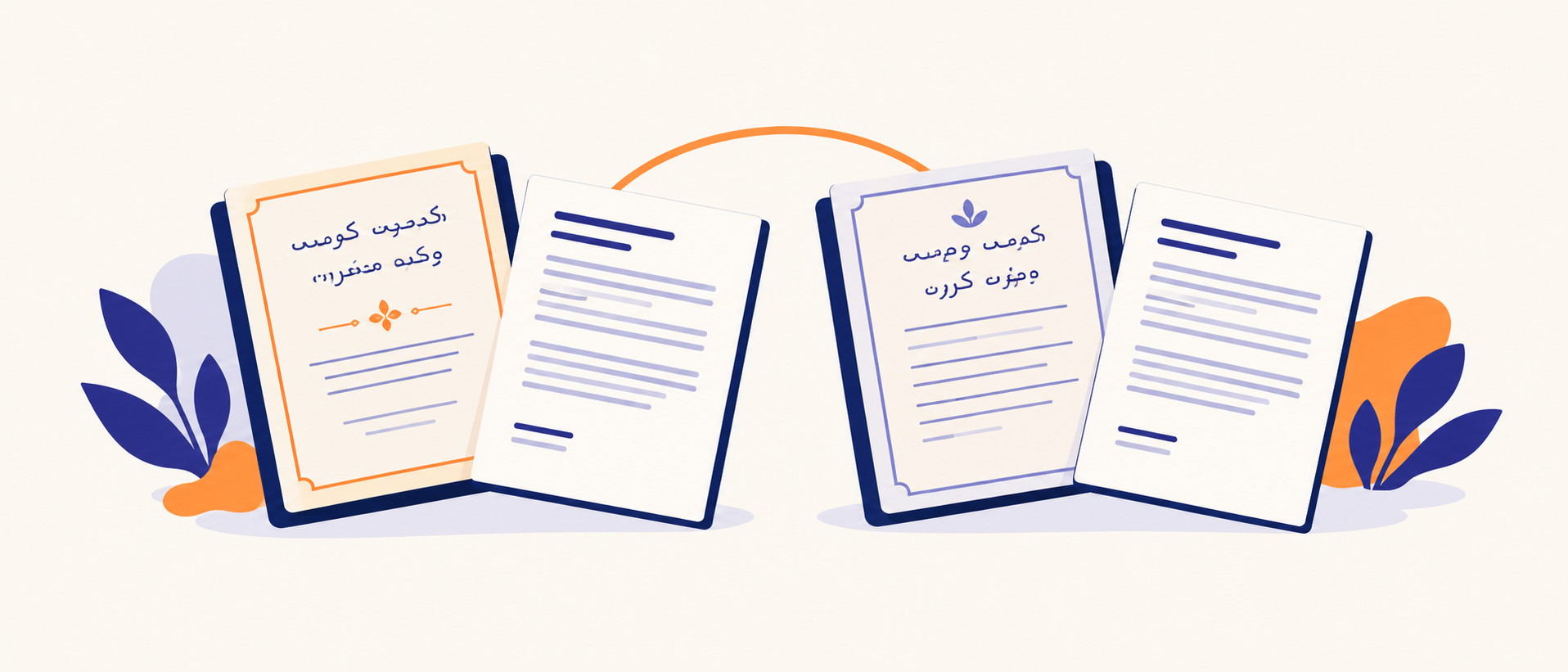
Long-Term Visit Pass translation in Singapore converts non-English family documents into English for an ICA or MOM application. Applicants should submit a complete, accurate translation with the corresponding source document and follow the instructions for the specific pass and applicant category. ICA administers relevant Long-Term Visit Pass applications, while MOM administers the Dependant's Pass for eligible family members of work pass holders.[2][3] Applicants seeking general information about eligibility and the wider process should also consult a complete Singapore Long-Term Visit Pass guide.
Which documents may require LTVP translation?
Any required document written wholly or partly in a language other than English may need an English translation.
Family relationship evidence commonly includes marriage certificates, birth certificates, adoption records, divorce orders, custody documents and name-change records. The documents required in an individual ICA application depend on the applicant's relationship to the sponsor and the application circumstances.[2]
Applicants should translate relevant stamps, handwritten entries, endorsements and notes as well as the main printed text. An untranslated annotation can affect how an officer interprets a name, date, relationship or document status.
Passports and identity documents may also contain non-English text. Applicants should check the application checklist before ordering a visa translation because an English-language passport data page may not require separate translation.
What is the difference between LTVP translation and Dependant's Pass translation?
The main difference is the authority and application route: ICA handles relevant LTVP applications, while MOM handles Dependant's Pass applications for eligible family members of work pass holders.[2][3]
| Translation issue | Long-Term Visit Pass | Dependant's Pass |
|---|---|---|
| Responsible authority | ICA administers the relevant LTVP application.[2] | MOM administers the Dependant's Pass.[3] |
| Typical relationship evidence | The application may require records proving marriage, parentage, adoption or another qualifying family relationship.[2] | The application may require documents establishing the dependant's relationship to the work pass holder.[3] |
| Translation approach | The applicant should follow the document instructions shown for the relevant ICA application category.[2] | The employer or appointed employment agent should follow MOM's current supporting-document instructions.[3] |
A translation prepared for one authority should not automatically be assumed to satisfy another authority's workflow. Applicants should check the current checklist for the exact pass before submission.
What should a certified family-document translation contain?
A certified translation should reproduce the complete meaning of the source document and identify the translator or translation provider responsible for its accuracy.
A submission-ready translation should include the names, dates, registration numbers, issuing authority, marginal notes, stamps and seals visible in the source document. The translation should mark text that is illegible rather than guessing what it says.
Name spellings should match the passport wherever the source text permits an equivalent rendering. A translator may add a concise note when a person's name has multiple accepted transliterations, but the translator should not alter the underlying civil record.
Certification, notarisation and legalisation are different processes. Certification concerns the translation's accuracy, notarisation authenticates a signature or document-related declaration, and legalisation or apostille procedures concern cross-border recognition of public documents. The receiving authority's instructions determine which process is relevant.
How should applicants prepare documents for translation?
Applicants should provide clear, complete scans and confirm the passport spelling of every relevant name before translation begins.
- Check the current application checklist. Identify the documents requested for the specific LTVP, Dependant's Pass or visa route on the relevant ICA or MOM page.[2][3]
- Scan the entire document. Include every page, reverse-side entry, border, stamp, seal and handwritten note that forms part of the record.
- Provide passport spellings. Supply the passport data page or type the applicable names exactly as shown in the passport.
- Explain known variations. Flag maiden names, married names, aliases and different romanisation systems before the translator prepares the final version.
- Request the correct service. State whether the application requires translation only, certified translation, notarisation or another supporting formality.
- Review the completed translation. Compare names, dates, document numbers and family relationships against the source before submission.
- Submit the matching source and translation. Keep the files together and follow the relevant portal's current upload instructions.
How much does LTVP translation cost in Singapore?
Bablio lists certified translation services from S$68, although the final price depends on the document and required services.[1]
Page count, language pair, handwriting, formatting complexity, urgency and notarisation requirements can affect the quotation. Applicants should provide the complete document when requesting a price because a cropped sample may omit text, stamps or reverse-side entries.
Bablio states that its translations are completed by human translators and that same-day turnaround is available.[1] Same-day completion depends on document length, language availability, source quality and the time of instruction, so applicants should confirm the delivery time before relying on it.
How long does a certified translation take?
A short and clearly scanned civil document may be completed on the same day when the provider offers urgent capacity, but turnaround times vary.
Bablio advertises same-day turnaround for its translation service.[1] Longer records, uncommon language pairs, handwritten documents, notarisation and clarification of inconsistent names can extend completion time.
Applicants should arrange translation before the application deadline. Additional time allows the translator to resolve illegible text and allows the applicant to review critical details before uploading the files.
What translation mistakes can delay an application?
Incomplete text, inconsistent names and missing source pages are the most important preventable translation problems.
Common submission risks include cropped seals, omitted reverse pages, untranslated handwritten notes, incorrect dates, inconsistent romanisation and poor-quality scans. A family relationship may be harder to verify when the translated spelling does not correspond with the sponsor's or applicant's passport.
Applicants should not edit a certified translation themselves. The translation provider should issue a corrected version when a factual or typographical error is found, preserving a clear and consistent final document.
Can one translation be used for ICA, MOM and other Singapore authorities?
The same accurate translation may be reusable, but each receiving authority can apply its own document, certification and submission requirements.
Bablio states that it formats certified translations for acceptance by ICA, MOM, the Registry of Marriages, LTA and the Singapore courts.[1] That statement describes Bablio's service and does not replace the receiving authority's case-specific review.
Applicants should verify whether the authority needs the source document, a certified copy, notarisation, an apostille or another formality. Approval of an application is not guaranteed merely because a translation was accepted as a supporting document.
How does a translation provider handle inconsistent names?
A translation provider should preserve the source record while making genuine transliteration differences clear.
Consider an anonymised applicant whose marriage certificate uses one romanised surname while the passport uses another spelling derived from the same non-Latin script. The translator should reproduce the source text accurately, use the passport spelling where an appropriate equivalence can be established, and add a translator's note when clarification is necessary.
The applicant should provide supporting evidence for an actual legal name change rather than asking the translator to rewrite the civil record. A translation explains source content; a translation does not amend the document issued by a government authority.
What should applicants check before submitting a translated document?
Applicants should compare the translation against both the source document and the application form before uploading it.
Use this final review:
- Every source page is present and readable.
- Every relevant section has been translated.
- Names correspond with passport spellings or include an appropriate explanation.
- Dates use an unambiguous format.
- Marriage, birth and adoption relationships are described accurately.
- Registration numbers, stamps and seals have not been omitted.
- The certification details are complete.
- The source document and its translation are grouped according to the portal instructions.
- File names clearly identify the applicant and document type.
- The files remain within the application portal's current technical limits.
A final comparison can identify a simple inconsistency before it becomes a request for clarification.