
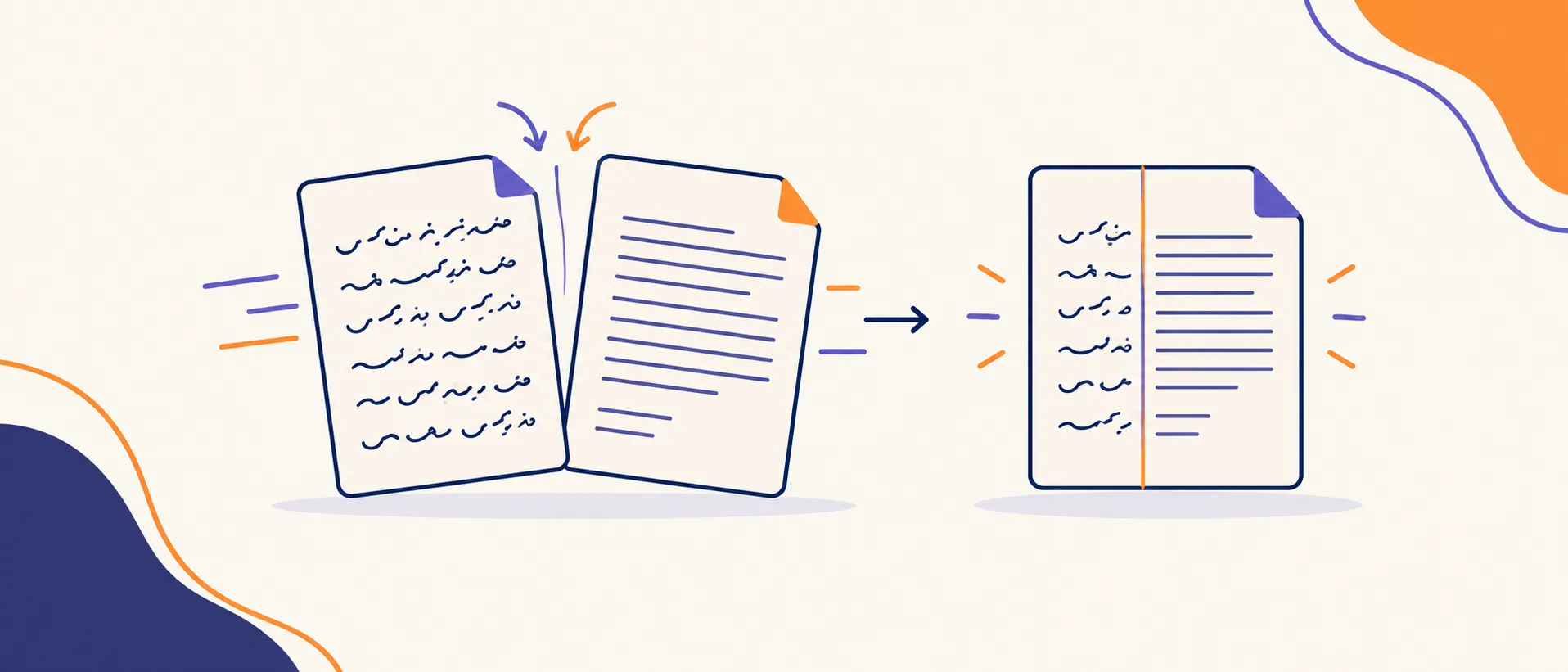
Employment Pass translation in Singapore means converting a non-English Employment Pass document into English and submitting both versions together as one file. MOM states: “For non-English documents, you must upload the original document together with an English translation as 1 file. The translation can be done by a translation service provider.”[1] Foreign professionals should arrange EP translation before their employer or employment agent uploads the supporting documents. A certified translation improves traceability, but Employment Pass approval is not guaranteed.
When does an Employment Pass document need translation?
An Employment Pass document needs translation when any information relevant to the application appears in a language other than English.
MOM requires the complete original-language document and its English translation to be uploaded together as one file.[1] The requirement can apply to educational certificates, transcripts, professional records, employment evidence, name-change documents and other supporting material requested during assessment.
A document that contains some English text may still need translation when stamps, annotations, grades, handwritten entries or reverse-side information appear in another language. A complete translation should account for every material element rather than translating only the main printed text.
The guidance below covers Employment Pass submissions. Readers who need the general rules for certification, notarisation and official document preparation should also consult the broader certified translation in Singapore guide.
Which Employment Pass documents commonly require English translation?
Foreign-language educational and supporting records commonly require English translation when they are submitted to support an Employment Pass application.
| Employment Pass document | Content that should appear in English | Preparation point |
|---|---|---|
| Degree or diploma | Institution, candidate name, qualification, field of study, award date, stamps and signatures | Preserve the name and qualification exactly as shown |
| Academic transcript | Subjects, grades, credits, dates, grading notes and seals | Keep the table structure easy to compare with the original |
| Professional certificate | Issuing body, registration details, validity dates and endorsements | Translate every material annotation |
| Employment record | Employer, position, employment period, duties and signatory details | Keep dates and job titles internally consistent |
| Name-change evidence | Former name, current name, date and legal basis for the change | Match the application to the passport and supporting records |
| Explanatory evidence | Relevant facts, dates, reference numbers and issuing authority | Include the complete source document |
MOM lists the candidate’s passport particulars page and the company’s latest business profile or instant information registered with ACRA among the standard Employment Pass documents, and MOM may ask for other documents during its review.[1] A passport or ACRA record already issued entirely in English does not need an English translation.
What does MOM accept as an English translation?
MOM permits a translation service provider to prepare the English translation for a standard Employment Pass submission.
MOM’s published document guidance does not name a general panel of approved translation companies. MOM instead states that the translation can be done by a translation service provider.[1]
MOM’s work-pass FAQ states that self-translations of foreign-language educational documents are not accepted. MOM accepts translations from the educational institution where the applicant studied and from professional translation service providers; the translation must cover all information shown on the educational document and be endorsed by the translator.[2]
A robust EP translation therefore identifies the provider, source language, target language and document translated. A signed or stamped certification statement should confirm that the translation is complete and accurate.
How should an Employment Pass translation be prepared?
The employer should collect a complete source document, obtain an accurate human translation and combine both versions into one clear upload file.
- Read the document request. Identify whether MOM has requested a translation, qualification verification or both.
- Collect the complete original. Include every page, reverse side, attachment, stamp, seal and amendment that forms part of the record.
- Create a legible scan. Check names, dates, grades, registration numbers and handwritten entries at normal viewing size.
- Provide identity references. Give the translator the passport spelling of the candidate’s name and flag any genuine name variation.
- Translate all material content. Translate or describe headings, body text, stamps, seals, annotations and handwritten entries. Mark genuinely unreadable text as illegible instead of guessing.
- Check the certification. Confirm that the final translation identifies the provider and certifies the translated content.
- Combine the documents. Place the original document together with the English translation in one file, as MOM requires.[1]
- Review the final upload. Confirm that pages are complete, correctly ordered and readable after file compression.
- Keep the submitted version. Retain the exact file used in the application so that later questions can be answered consistently.
Does MOM require a certified or notarised translation?
MOM’s general Employment Pass translation rule permits a translation service provider and does not impose notarisation on every non-English document.[1]
A certified translation records responsibility for the accuracy and completeness of the English text. A notarised translation adds a Notary Public process to the translator’s or provider’s declaration. The two services perform different functions.
A document-specific instruction may still require notarisation, legalisation or another authentication step. Applicants should follow the exact request attached to the document instead of purchasing notarisation automatically.
Bablio states that it formats certified and notarised translations for ICA, MOM, LTA, courts and embassies, with notarisation and apostille available where required.[3] MOM retains authority to assess every document and application.
Is EP translation the same as qualification verification?
EP translation explains the content of a foreign qualification, while qualification verification establishes whether the qualification is authentic and awarded by an accredited institution.
MOM requires employers to ensure that candidates’ qualifications are authentic and awarded by accredited institutions. MOM accepts verification proof only from the sources identified in its current Employment Pass guidance.[1]
A translated degree cannot replace required verification proof. A notarised copy also does not automatically satisfy MOM’s qualification-verification requirement because notarisation and verification answer different evidential questions.
| Process | Main purpose | Typical provider | Replaces the original? |
|---|---|---|---|
| English translation | Converts foreign-language content into English | Translation service provider | No |
| Translation certification | Records responsibility for completeness and accuracy | Translator or translation company | No |
| Notarisation | Authenticates a signature, declaration or copy | Notary Public | No |
| Qualification verification | Checks authenticity and institutional accreditation | MOM-accepted verification source | No |
Do the same translation rules apply to an S Pass?
MOM applies the same one-file translation instruction to non-English S Pass supporting documents.
MOM states that applicants must upload the original non-English document together with an English translation as one file and that a translation service provider can prepare the translation.[4] The same preparation discipline therefore supports both EP translation and S Pass work pass translation.
Applicants should still check the document page for the specific pass. Employment Pass, S Pass and Work Permit processes can request different supporting evidence even when the underlying translation method is similar.
What mistakes can delay document review?
Incomplete translation, inconsistent identity details and incorrect file preparation can lead to clarification or replacement-document requests.
| Mistake | Why it creates a problem | Better approach |
|---|---|---|
| Uploading only the English version | MOM requires the original and translation together | Combine both versions into one file |
| Uploading the versions separately | Separate files do not follow the stated one-file instruction | Merge the corresponding pages before submission |
| Omitting stamps or notes | Material dates or endorsements may be missing | Translate or describe every relevant visible element |
| Changing the spelling of a name | The application and supporting records may appear inconsistent | Use the passport spelling and explain legitimate variations |
| Treating translation as verification | MOM may still lack evidence of authenticity | Obtain verification proof separately when required |
| Submitting blurred scans | The reviewer cannot reliably compare the two versions | Rescan and inspect the final combined file |
| Using machine-only output | Names, seals and specialised terms may be mistranslated or omitted | Use an accountable human translation process |
MOM advises applicants to submit documents correctly to avoid delays and may request additional documents during its review.[1] A careful pre-submission check cannot guarantee approval, but it can reduce avoidable document problems.
How much does Employment Pass translation cost in Singapore?
Employment Pass translation cost depends on the language, document type, page density, legibility and required turnaround.
Bablio lists standard one-page civil documents from around S$49 per page, with notarisation and SAL authentication or apostille priced as separate line items.[5] A final quote may differ for multi-page transcripts, uncommon languages, specialist terminology, handwritten content or urgent work.
A useful quotation should separate translation, certification, formatting, urgent handling, notarisation and delivery. Transparent line items help applicants avoid paying for notarisation when the relevant MOM instruction requires only an English translation.
How quickly can an EP translation be completed?
A short, legible EP translation may qualify for same-day service, while longer or complex records require more time.
Bablio states that same-day service is available for many single-page documents confirmed before noon during business hours.[6] Bablio also states that every certified translation is produced and verified by qualified human translators and that no document is delivered machine-only.[7]
Turnaround varies with document length, language availability, scan quality, handwriting and specialist terminology. Applicants should reserve time for translation review, corrections and file preparation before the employer’s submission deadline.
How does Employment Pass translation work in practice?
An anonymised degree-certificate example shows why translation and verification must remain separate.
A foreign professional held a university degree issued in a language other than English. The employer first obtained an English translation and assumed that the translation also proved the degree’s authenticity.
The corrected document set contained the complete original degree, the certified English translation and separate qualification-verification evidence. The employer combined the original and translation into one file and submitted the verification proof in the appropriate part of the Employment Pass application.
The example illustrates document preparation rather than an approval formula. MOM assesses each Employment Pass application under the applicable eligibility and evidential requirements, and approval is not guaranteed.
How should applicants choose a work pass translation provider?
Applicants should choose a provider that delivers complete human translation, clear certification and MOM-ready file preparation.
A suitable provider should confirm the language pair, document scope, delivery time and correction process before work begins. The provider should also preserve names, dates, grades, stamps and annotations without adding unsupported interpretations.
Bablio states that it provides certified translations for Employment Pass, S Pass, Work Permit and other MOM submissions.[3] Bablio’s MOM-focused service uses 100% human translation and offers same-day turnaround for suitable documents.[6][7]
Provider claims do not bind MOM. Applicants should judge the finished Employment Pass document by its accuracy, completeness, certification and compliance with the current submission instructions.
What do applicants ask about Employment Pass translation in Singapore?
The main questions concern file format, self-translation, notarisation, verification, pricing and processing time.
Does MOM require English translation for every foreign-language Employment Pass document?
MOM requires a non-English supporting document to be uploaded with its English translation as one file.[1]
Can I translate my own degree certificate?
MOM does not accept self-translations of foreign-language educational documents; MOM accepts translations from the educational institution or a professional translation service provider when the translation meets its stated conditions.[2]
Must the original and translation be uploaded separately?
MOM requires the original document and English translation to be uploaded together as one file.[1]
Does every EP translation need notarisation?
MOM’s general Employment Pass translation rule does not require notarisation for every document.[1]
Can certified translation replace qualification verification?
Certified translation cannot replace required verification proof because translation explains content while verification addresses authenticity.
Does an English-language document need translation?
An entirely English document does not need English translation. Foreign-language stamps, annotations or reverse-side entries may still require translation.
How much does Bablio charge for certified translation?
Bablio lists standard one-page civil documents from around S$49 per page, while additional services are quoted separately.[5]
Does Bablio use machine-only translation?
Bablio states that every certified translation is produced and verified by qualified human translators and that no document is delivered machine-only.[7]
Does a correct translation guarantee Employment Pass approval?
A correct translation supports document assessment, but MOM decides the Employment Pass application and approval is not guaranteed.