
Citizenship oath-taking translation means converting every required foreign-language record into English in a form accepted by the Immigration & Checkpoints Authority (ICA). ICA requires official translations for citizenship documents that are not in English and may decline to accept insufficient documentation.[1] Applicants should arrange translation and any required notarisation before their ICA appointment, while following the document list in their citizenship notice because the exact records depend on the applicant and stage.
What is citizenship oath-taking translation?
Citizenship oath-taking translation is the official English translation of a foreign-language document required during Singapore citizenship registration or oath-taking.
The relevant document might be a birth certificate, household register, marriage certificate, deed poll or foreign citizenship renunciation certificate. Translation makes the document readable in English; notarisation or embassy attestation establishes the form of certification that ICA accepts.
ICA states that applicants must provide certified true copies of original documents and official translations for documents in languages other than English.[1] A plain self-translation does not satisfy ICA's published translation categories unless it receives the required embassy attestation or notarisation.
The Singapore citizenship oath is formally called the Oath of Renunciation, Allegiance and Loyalty. The official oath form records the applicant's renunciation of loyalty to foreign states and allegiance to the Republic of Singapore.[2]
Which citizenship documents may need English translation?
Every required document containing substantive text in a language other than English should receive an official English translation.
| Document | When it may be relevant | Translation preparation |
|---|---|---|
| Birth certificate or household register | ICA's citizenship checklist requires this record where the birth was not registered in Singapore.[3] | Translate names, dates, registration details, annotations, stamps and both sides where applicable. |
| Marriage certificate | ICA's citizenship checklist requires this record where the marriage was not registered in Singapore.[3] | Keep names and marriage dates consistent with passports, identity records and the ICA application. |
| Adoption, custody, divorce or separation records | ICA lists these records for applicable applicants and family situations.[3] | Translate the complete order or certificate rather than selected clauses. |
| Deed poll or religious certificate | ICA lists these records where an applicant relies on a change of name.[3] | Preserve the exact old name, new name and execution details. |
| Educational or professional documents | ICA lists educational certificates, transcripts, skill certificates and professional licences for applicable applicants.[3] | Translate institutional names, qualifications, subjects, grades and award dates consistently. |
| Overseas employment or business records | ICA's checklist includes employment letters, overseas tax records and specified business documents where applicable.[3] | Retain the original financial figures, currencies, dates and legal entity names. |
| Foreign Citizenship Renunciation Certificate | ICA requires this certificate for the Oath of Renunciation, Allegiance and Loyalty taken by relevant minors after age 21.[4] | Provide an official translation if the certificate is not in English and retain the original for presentation. |
ICA may request supporting documents beyond its standard checklist.[3] Applicants should review every page of the latest ICA notice instead of assuming that a document used earlier will remain sufficient for completion formalities.
What forms of translation does ICA accept?
ICA accepts three published forms of official translation for foreign-language citizenship documents.
ICA accepts:
- Translations provided by the embassy of the country or place that issued the document.[1]
- Translations provided by a notary public in Singapore or the country or place that issued the document.[1]
- Privately translated documents attested by the issuing country's embassy or notarised by a notary public in Singapore or the country or place that issued the document.[1]
ICA does not endorse any private translation company or entity.[1] A translation provider may prepare a document to ICA's published standard, but only ICA determines whether the evidence submitted for a particular citizenship matter is sufficient.
Bablio uses 100% human translation and formats citizenship documents for submission to ICA. Bablio can also coordinate the notarisation stage when the selected ICA acceptance route requires a privately translated document to be notarised.
What is the difference between translation, certification and notarisation?
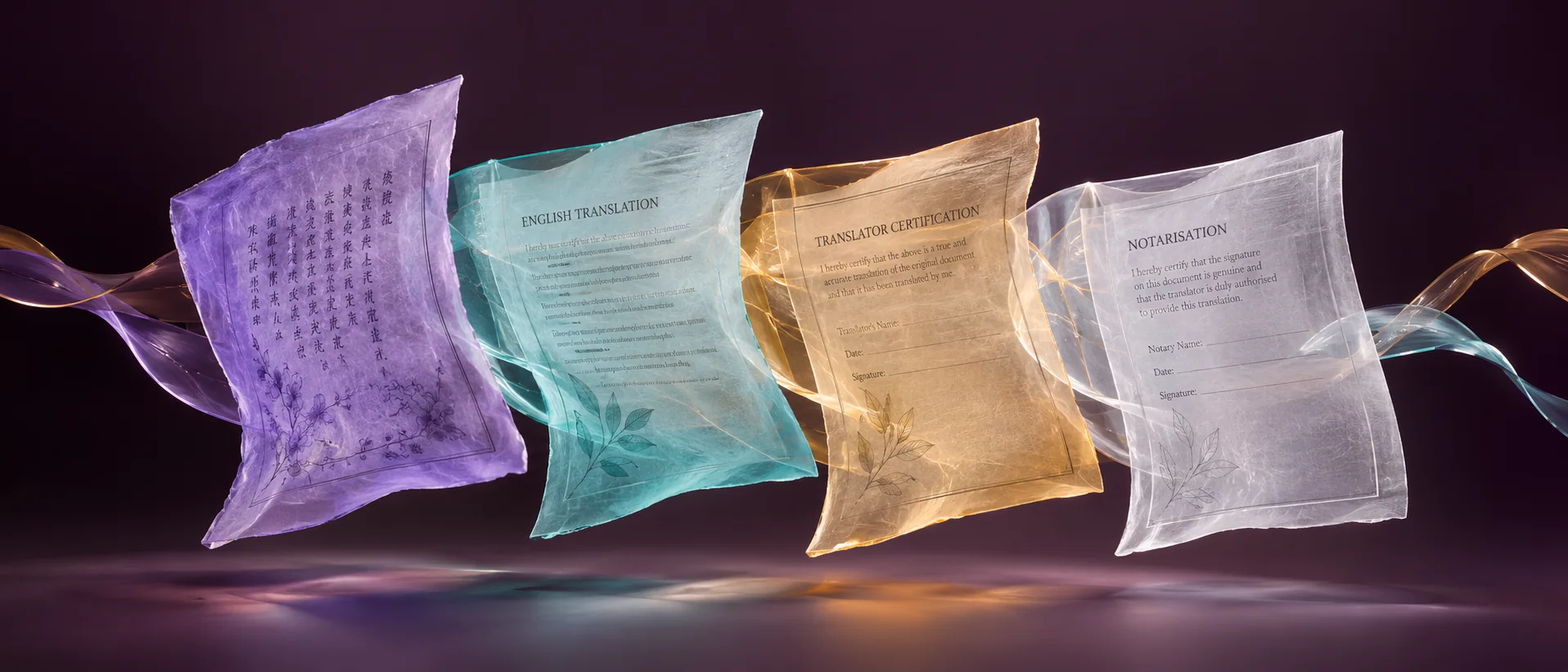
Translation converts the document into English, certification identifies and confirms the completed translation, and notarisation adds the formal act of a notary public.
A translator should reproduce the substantive contents of the source document without changing names, dates, figures or legal meaning. A complete translation should also account for seals, stamps, handwritten annotations and text printed on the reverse side.
A translation certificate normally identifies the source and target languages, the translated document and the person or organisation responsible for the work. The certificate supports traceability, but ICA's published rules still require the translation to fit one of its accepted categories.[1]
Notarisation is relevant when a private translation relies on a notary public for ICA acceptance. A notary public does not replace the translator or rewrite the translation. The notarial act authenticates the relevant declaration, signature or document in the form used for the submission.
How should applicants prepare translated documents for ICA oath-taking?
Applicants should work backwards from the ICA appointment notice and complete translation, review and notarisation before the appointment date.
- Read the ICA notice in full. Identify every original, copy, renunciation record and translated document requested for the specific citizenship stage.
- Check every document for non-English text. Review the front, reverse, attachments, stamps, seals and handwritten annotations.
- Provide clear colour scans. Blurred text, cropped registration numbers and missing page edges can make accurate citizenship document translation impossible.
- Choose an ICA-accepted translation route. Select an embassy translation, a translation provided by a notary public, or a private translation followed by the required embassy attestation or notarisation.[1]
- Verify names and dates against identity documents. Flag differences in spelling, name order, transliteration, previous names and date formats before finalisation.
- Review the English translation against the source. Confirm that every page, stamp, table, number and annotation appears in the translated set.
- Complete notarisation where required. Avoid booking the notarial step before the translation has passed the factual review.
- Arrange the submission set. Keep each original document together with its English translation, certification page, notarial material and requested copy.
- Bring the documents specified by ICA. Adult applicants should follow their citizenship approval and appointment instructions; the published minor oath-taking process requires an Identity Card and Foreign Citizenship Renunciation Certificate.[4]
ICA states that insufficient documentation may result in non-acceptance and that additional documents may be requested.[1] Early preparation leaves time to correct discrepancies without relying on approval of a last-minute replacement.
How much does citizenship document translation cost and how long does it take?
Bablio's citizenship document translation starts from S$68, and same-day turnaround is available for suitable documents.
The final cost depends on the language, page count, word volume, legibility, formatting complexity and whether notarisation or another certification step is required. A one-page certificate normally requires less production work than a handwritten household register, court order or multi-page academic transcript.
Same-day turnaround applies most naturally to clear, short and complete records submitted early enough for translation and checking. Notarial scheduling, embassy attestation and unclear source documents can extend the overall timeline.
Applicants should provide the complete document set when requesting a price. Sending one visible page and revealing additional pages after translation can change both the fee and delivery time.
Why do citizenship translations get delayed or rejected?
Citizenship translations fail most often because the submission is incomplete, inconsistent or outside ICA's accepted translation categories.
Common problems include:
- A missing reverse page. A document may contain registration notes, legalisation details or amendments on the back.
- An incomplete translation. Stamps, seals, marginal notes and handwritten entries form part of the source record.
- Different name spellings. A translation should not silently choose one spelling when the source document and passport differ.
- An unsupported private translation. ICA accepts a privately translated document only when it receives the published embassy attestation or notarisation.[1]
- A poor scan. The translator cannot confirm text hidden by glare, blur, folds or cropped edges.
- An altered date or number format. Translations must preserve the underlying information even when explanatory formatting is added.
- A document-by-document approach. Family records often contain connected names, marriages and dates that require consistent treatment across the complete set.
ICA does not guarantee acceptance merely because a document carries a translation certificate.[1] The translation, supporting certification and underlying record must collectively meet the requirements for the applicant's citizenship process.
How does a well-prepared oath-taking translation file look in practice?
A well-prepared file lets ICA compare each foreign-language original with a complete, consistently named and properly authenticated English version.
Consider a composite example involving a citizenship applicant whose foreign birth certificate and marriage certificate use different English spellings of the applicant's name. A rushed translation repeats both spellings without explanation, while the ICA application uses the passport spelling.
A structured workflow records the spelling difference at intake, translates each source faithfully and applies the passport spelling only where an explanatory translator's note is appropriate. The workflow then checks the applicant's name, parents' names, document numbers and dates across both translations before notarisation.
The final set places each source document beside its English translation and associated certification material. The organised presentation does not guarantee acceptance, but it removes avoidable ambiguity and makes the document chain easier to examine.