
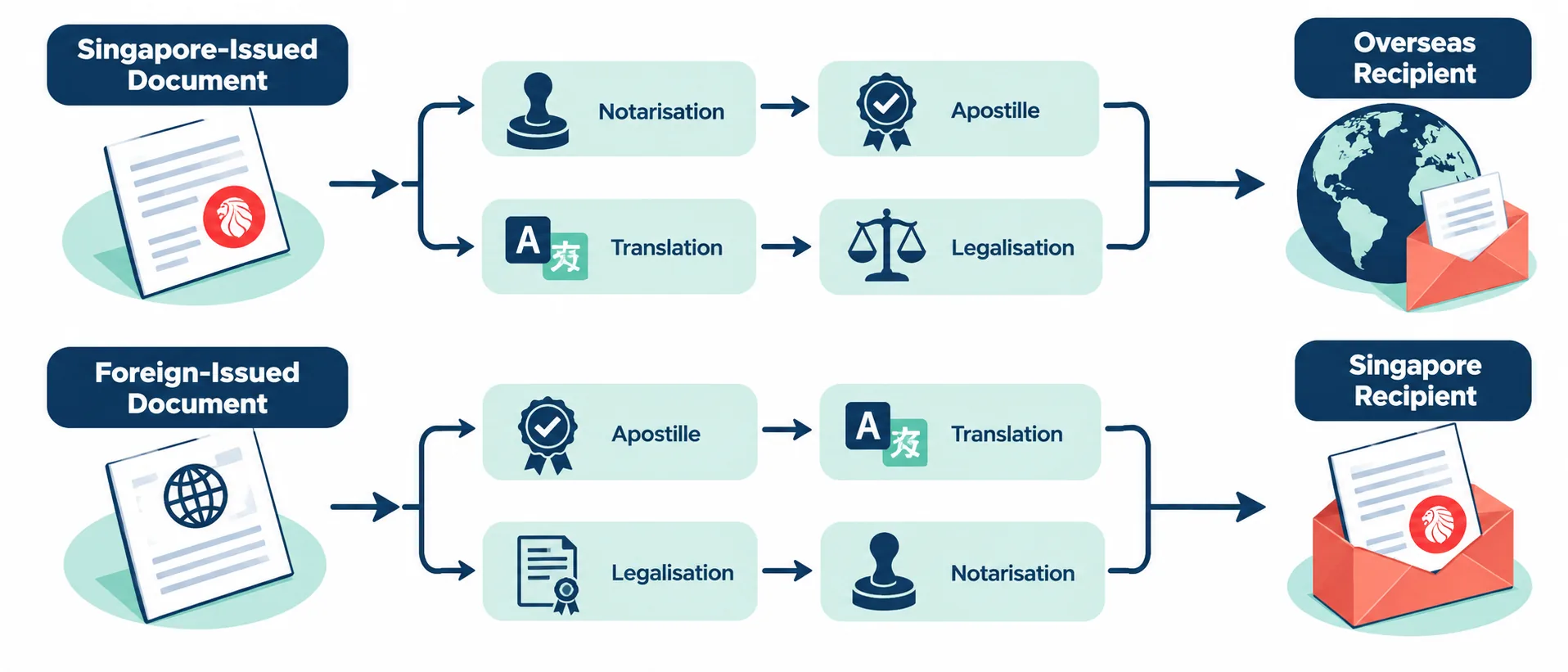
An apostille in Singapore is a certificate issued by the Singapore Academy of Law (SAL) to authenticate the origin of a Singapore public document or notarial certificate for use overseas.[1] Singapore-issued documents go through SAL, while foreign-issued documents needed in Singapore must obtain any required apostille from the competent authority in their country of origin.[2] The destination country, document type and receiving authority determine whether apostille, further legalisation, certified translation or a combination of these services is required.
What is an apostille in Singapore?
An apostille authenticates the origin of a public document so that it can be presented in another country under the Hague Apostille Convention.
The Apostille Convention applies to public documents executed in one Contracting State and produced in another Contracting State.[2] Covered documents include court documents, administrative documents, notarial acts and official certificates attached to privately signed documents.[2]
An apostille certifies the authenticity of the signature, the capacity of the person who signed the document and, where applicable, the identity of its seal or stamp.[2] An apostille does not confirm that every statement inside the document is accurate, approve the transaction described in the document or translate its contents.
Singapore deposited its instrument of accession on 18 January 2021, and the Apostille Convention entered into force for Singapore on 16 September 2021.[3] SAL now serves as Singapore's designated Competent Authority for legalisation and apostillation of Singapore documents intended for overseas use.[4]
The phrase “apostilled meaning” therefore refers to a document whose signature, seal or stamp has been authenticated through the Convention process. Acceptance for a particular transaction remains subject to the receiving authority's document requirements.
Which Apostille Singapore workflow applies to your document?
The place where the document was issued determines the correct apostille or document legalisation Singapore workflow.
| Document direction | Correct starting point | Main authority | Likely next step |
|---|---|---|---|
| Singapore-issued document for use overseas | Identify whether the document is public, private or commercial | SAL, with a Notary Public or Chamber of Commerce where required | Present the SAL apostille directly in a Convention country or obtain further embassy legalisation for a non-Convention country |
| Foreign-issued document for use in Singapore | Check whether the issuing country and Singapore are bound by the Apostille Convention | Competent authority in the issuing country | Present the apostilled document to the Singapore recipient, subject to translation and agency requirements |
| Foreign-issued document from a non-Convention country | Ask the Singapore recipient which authentication chain it requires | Authorities in the issuing country and relevant diplomatic or consular mission | Complete the traditional legalisation chain before submission in Singapore |
The Apostille Convention requires the apostille to be issued by a competent authority of the state from which the document emanates.[2] SAL therefore apostilles Singapore documents; SAL does not replace the foreign competent authority for a document issued abroad.
The current HCCH status table identifies Singapore as a Contracting Party and records the countries for which the Convention is in force.[5] Applicants should check the live status table because new countries may join and an accession may have a future effective date.
Which Singapore documents can SAL apostille?
SAL can directly legalise verifiable Singapore public documents, while private and certain commercial documents require an additional certification step.
| Document category | Examples | Preparation before SAL |
|---|---|---|
| Singapore public documents | Marriage certificates, birth certificates and court documents | SAL can directly legalise verifiable originals; computer-generated documents must first be certified by the issuing department where SAL requires it.[1] |
| Private or non-government documents | Powers of attorney, declarations, contracts and privately issued certificates | A Singapore Notary Public must notarise the document before SAL authentication.[1] |
| Commercial documents | Invoices, bills of sale, certificates of origin and fumigation certificates | An accepted Chamber of Commerce or the Singapore Manufacturing Federation must first certify or sight the document.[1] |
| Certified true copies | Copies required instead of an original | The original must be presented at the SAL counter so SAL staff can make the copy for legalisation.[1] |
| Digitally issued documents | Eligible documents generated by an issuing agency | The digital document must be printed before paper legalisation.[6] |
SAL requires original documents for its standard legalisation service and does not accept an ordinary copy as a substitute.[1] A laminated original should be replaced with a certified true copy or extract obtained from the issuing agency before submission to SAL.[1]
SAL does not legalise publicly available records that can be searched or downloaded from an official government website, such as published Acts, Rules and lists of government bodies.[6]
How do you apostille a Singapore-issued document?
Applicants must prepare the document according to its category, submit an online SAL request and present the eligible document for legalisation.
- Confirm the overseas recipient's requirements. Ask whether the recipient requires an original, certified true copy, paper apostille, e-Apostille, notarisation or certified translation. SAL states that the destination country or receiving party determines whether legalisation is required.[6]
- Classify the document. Identify the document as a Singapore public document, private document, commercial document or digitally issued document. The classification determines whether another authority must act before SAL.
- Complete any preliminary certification. Take a private document to a Singapore Notary Public. Take an applicable commercial document to an accepted Chamber of Commerce or the Singapore Manufacturing Federation.[1]
- Submit the SAL request and make payment online. SAL requires an online request and online payment for its legalisation service.[1] SAL accepts online payment by Visa or Mastercard and does not accept cash at the counter.[6]
- Prepare the submission set. Bring the original public document or printed copy of an eligible digitally issued document, together with the QR code on the SAL invoice. A notarised submission must include the Notarial Certificate and all documents attached to it.[6]
- Present the document to SAL. Appointments are not required for the current counter service.[6] SAL is located at 1 Coleman Street, #08-06, The Adelphi, Singapore 179803, and its regular counter hours are Monday to Friday from 9:00am to 4:30pm, excluding public holidays.[1]
- Check whether further legalisation is required. A Singapore document going to a Contracting Party can generally be sent to the recipient after SAL apostillation. A document going to a non-Convention country still requires further legalisation through that country's foreign mission in Singapore.[6]
Bablio offers apostille services and can coordinate the document-preparation stages where an applicant needs apostille, notarisation or translation support. The overseas recipient's written requirements should remain the basis for selecting the services.
How do you prepare a foreign-issued document for use in Singapore?
A foreign-issued document must follow the authentication route in its country of origin before it is submitted in Singapore.
- Ask the Singapore recipient what it requires. The receiving authority may require the original document, an apostille, traditional legalisation, an English translation or a certified copy.
- Check the Convention status of the issuing country. The HCCH status table shows whether the Apostille Convention is in force between the issuing state and Singapore.[5]
- Use the issuing country's competent authority. Article 3 of the Convention provides that the apostille is issued by the competent authority of the state from which the document emanates.[2] A foreign birth certificate, court record or university document therefore starts with the designated authority in its country of origin.
- Use traditional legalisation when the Convention does not apply. A document from a non-Convention country may require authentication by authorities in the issuing country followed by diplomatic or consular legalisation. The exact chain should be confirmed with the Singapore receiving agency and the relevant Singapore overseas mission.
- Arrange translation separately when required. An apostille does not translate the underlying document. A document written in a language that the Singapore recipient does not accept may need a certified English translation.
A foreign apostille normally stays attached to the source document or an allonge. Article 4 of the Convention permits the certificate to be placed on the document itself or on an attached allonge.[2] Applicants should avoid separating, rebinding or altering the apostille package unless the receiving authority expressly permits it.
What is the difference between an apostille and a certified translation?
An apostille authenticates a document's official origin, while a certified translation renders its text into another language with a translator's certification.
| Feature | Apostille | Certified translation |
|---|---|---|
| Main purpose | Authenticates a signature, official capacity, seal or stamp | Makes the document understandable in the required language |
| Issued or completed by | A competent authority designated under the Apostille Convention | A qualified translation provider using the certification format required by the recipient |
| Verifies document contents | No | The certification addresses the translation's completeness and accuracy, not the truth of the source document |
| Replaces the other service | No | No |
| Common use | Cross-border recognition of public or notarised documents | Immigration, court, education, business and civil-status submissions involving another language |
Apostille vs certified translation is not an either-or decision when the receiving authority requires both authentication and an English or foreign-language version. The correct order depends on what must be apostilled: the original public document, a notarised copy, the translator's declaration or a bundled notarial certificate.
Applicants should obtain written instructions from the recipient before translation or notarisation. Early confirmation reduces the risk of paying for a translation that later has to be reformatted, notarised or attached to a different document set.
How much does an apostille cost in Singapore?
SAL charges S$10.70 per legalised document, while notarised documents incur an S$87.20 SAL authentication fee plus the Notary Public's separate fee.
| SAL service | Current SAL fee | Additional cost to expect |
|---|---|---|
| Legalisation of an original public document | S$10.70 per document, including GST[1] | Courier, translation or service-provider fees where applicable |
| Legalisation of a certified true copy | S$10.70 per document, including GST[1] | S$1.07 SAL photocopying fee for each certified true copy legalised[1] |
| Authentication of a notarial certificate | S$87.20, including GST[6] | The Notary Public's separate notarisation fee |
| e-Apostille for an eligible ACRA document | S$10.70 per e-Apostille[7] | Cost of obtaining the eligible ACRA record where applicable |
SAL waives the separate S$10.70 legalisation fee for notarised documents that require SAL authentication.[1] The S$87.20 authentication fee remains payable, and the Notary Public charges a separate notarisation fee.[6]
SAL states that legalisation, authentication and photocopying payments are non-refundable.[1] Applicants should verify the destination, document format and recipient's acceptance requirements before paying.
How long does SAL apostille processing take?
SAL processes authentication of notarised documents over the counter, with the actual waiting time depending on the number of documents submitted.
SAL states that notarised documents are processed on the spot and returned immediately after processing.[6] Queue conditions, document quantity and verification issues can affect the total time spent at the counter.
The full apostille timeline can be longer because notarisation, issuing-agency certification, Chamber of Commerce certification, translation and courier delivery occur outside SAL. Applicants should allow additional time when the source document must be replaced, certified or corrected.
What are SAL e-Apostilles and who can use them?
SAL provides e-Apostilles for eligible ACRA records and for documents completed through its e-notarisation process.
The ACRA e-Apostille service currently covers Business Profiles and Business Certificates of Incorporation or Registration issued in Open Attestation format from 4 March 2023 onwards.[7] The ACRA service is completed remotely, and each eligible Open Attestation document requires its own e-Apostille.[7]
Documents notarised by a Singapore Notary Public can also receive an e-Apostille through the e-notarisation workflow.[6] The client requests that workflow through the Notary Public, and the digital documents are delivered through SAL's system without a visit to the SAL office.[6]
The receiving party should confirm that it accepts an e-Apostille before the applicant selects the digital format.[7] A printed copy of an e-Notarial Certificate is for reference only and has no legal effect.[6]
What documents should you prepare for SAL legalisation?
The submission set depends on whether the document is public, digital, notarised or being handled by a proxy.
| Situation | Documents or information to prepare |
|---|---|
| Original Singapore public document | Original document, online request details, payment confirmation and invoice QR code |
| Digitally issued Singapore document | Printed document, online request details, payment confirmation and invoice QR code |
| Notarised private document | Notarial Certificate and every document attached to that certificate |
| Certified true copy | Original document for SAL staff to photocopy |
| Proxy submission | Original hardcopy or eligible printout, invoice QR code and clear instructions about document type, destination and whether an original or copy is required |
| e-Apostille request | Eligible digital file and an accurate email address for delivery or access |
SAL permits a proxy to complete standard legalisation without an authorisation letter.[1] The document owner must attend personally when SAL verification requires access through the owner's Singpass or email account.[6]
A complete submission does not guarantee that SAL can legalise every document. SAL staff make the final decision after physically examining and verifying documents presented at the counter.[6]
Why do apostille and SAL legalisation requests fail or face delays?
Most avoidable problems arise from using the wrong workflow, submitting an unacceptable document format or overlooking the recipient's requirements.
A copy submitted without the original can be rejected because SAL's standard legalisation rules require original documents and do not accept ordinary copies.[1] An applicant who needs a certified true copy should bring the original for SAL staff to photocopy.
A private document can stall when it reaches SAL without prior notarisation. SAL can legalise a private non-government document only after a Singapore Notary Public has notarised it.[1]
A digital document can cause delay when the applicant expects SAL to print it. SAL requires digitally issued documents to be printed before counter submission and does not provide a printing service.[6]
A laminated original can be unsuitable for legalisation. SAL directs applicants to obtain a certified true copy or extract from the issuing agency when the original has been laminated.[1]
An apostille can still be unusable for the intended transaction when the recipient requires another format, translation or document version. Applicants should confirm the recipient's exact requirements before arranging SAL legalisation, translation or notarisation.
A non-Convention destination can require another step after SAL. SAL states that documents for non-Convention countries still require further legalisation through the relevant foreign mission in Singapore.[6]